
 Many forex traders dream of strong trends and explosive price movements. However, a significant portion of the forex market spends time moving sideways rather than trending strongly upward or downward. These periods, known as ranging or consolidating markets, can frustrate traders who rely exclusively on trend-following strategies.
Fortunately, traders who understand how to identify and trade range-bound conditions can find consistent opportunities. A successful sideways market forex strategy focuses on recognizing market structure, utilizing effective range trading forex techniques, applying proven support resistance strategy methods, adapting to low volatility trading environments, and incorporating reliable forex technical analysis tools.
This comprehensive guide explores how sideways markets develop, why they occur, and the most effective strategies for generating profits when currency pairs trade within established ranges.
Understanding Sideways Markets in Forex
A sideways market occurs when price moves within a defined range rather than establishing a clear trend.
During these periods, buyers and sellers are relatively balanced, preventing sustained movement in either direction.
For traders implementing a sideways market forex strategy, identifying these conditions early is critical.
Sideways markets often develop after strong trends, before major economic announcements, or during periods of uncertainty when traders lack conviction.
Unlike trending environments, range-bound conditions require a different approach to forex technical analysis and trade execution.
Understanding market structure is the foundation of successful range trading forex strategies.
Why Sideways Markets Occur
Currency markets enter consolidation phases for several reasons.
Central bank uncertainty, economic transitions, geopolitical events, and seasonal market behavior can all contribute to range-bound trading.
During these periods, traders often observe reduced momentum and increased respect for support and resistance levels.
A successful sideways market forex strategy recognizes that these conditions are normal and can provide valuable trading opportunities.
Many professional traders actively seek range-bound environments because predictable price behavior often enhances the effectiveness of a support resistance strategy.
Recognizing why markets consolidate helps traders adjust expectations and avoid forcing trend-based trades.
The Importance of Range Trading Forex
One of the most effective approaches during consolidation periods is range trading forex.
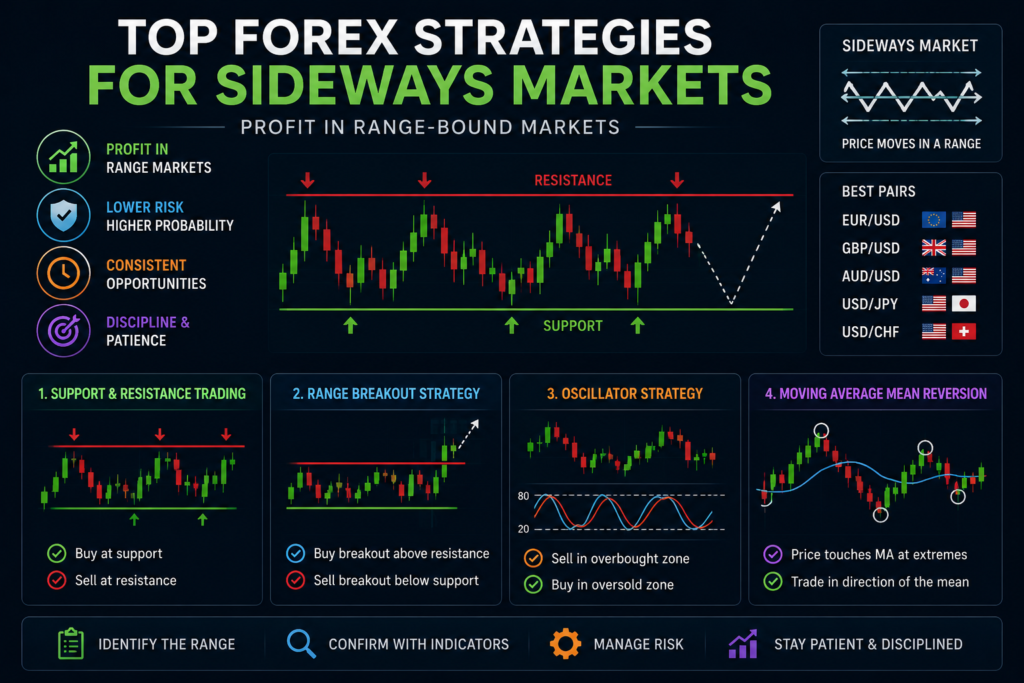
This strategy involves buying near support levels and selling near resistance levels while price remains contained within a range.
The core principle of range trading forex is that prices tend to oscillate between clearly defined boundaries until a breakout occurs.
Many experienced traders prefer range trading forex because it provides well-defined entry and exit points.
When combined with effective risk management, range trading forex can generate consistent opportunities during periods of market consolidation.
Success depends on accurately identifying range boundaries and avoiding premature breakout assumptions.
Building a Support Resistance Strategy
A strong support resistance strategy is essential for trading sideways markets.
Support levels represent areas where buying interest tends to emerge, while resistance levels indicate zones where selling pressure increases.
An effective support resistance strategy uses historical price action to identify these critical zones.
When price approaches support, traders may look for buying opportunities.
When price nears resistance, selling opportunities often emerge.
Many successful traders combine a support resistance strategy with candlestick patterns and momentum indicators to improve trade accuracy.
Mastering support and resistance remains one of the most valuable skills in forex trading.
Low Volatility Trading and Market Conditions
Sideways markets are often associated with reduced market activity and lower volatility.
As a result, traders must adapt to low volatility trading conditions.
During periods of low volatility trading, price movements may be smaller, requiring realistic profit expectations.
Traditional trend-following systems often struggle in these environments because breakouts frequently fail.
Instead, traders focusing on low volatility trading prioritize precision, patience, and disciplined risk management.
Understanding volatility conditions helps traders select appropriate strategies and avoid unnecessary losses.
Forex Technical Analysis in Sideways Markets
Effective forex technical analysis plays a critical role in identifying and trading ranging markets.
Technical indicators help traders recognize support and resistance zones, measure momentum, and evaluate potential breakout scenarios.
Popular tools used in forex technical analysis for range trading include:
Relative Strength Index (RSI).
Stochastic Oscillator.
Bollinger Bands.
Moving Averages.
Average True Range (ATR).
These indicators can enhance a sideways market forex strategy by providing additional confirmation for trade entries and exits.
Combining multiple forms of forex technical analysis often improves overall trading performance.
Identifying High-Probability Range Trading Setups
Not every range presents a quality trading opportunity.
Successful range trading forex requires identifying ranges with clearly defined boundaries and consistent price behavior.
Strong support and resistance zones improve the reliability of a support resistance strategy.
Traders should avoid entering positions in the middle of a range whenever possible.
Instead, focus on areas where risk can be controlled and reward potential remains favorable.
A disciplined sideways market forex strategy prioritizes quality setups over trade frequency.
Patience often produces better results than constant market activity.
The Role of Volume and Market Participation
Although volume data is less transparent in forex than in other markets, market participation still influences trading conditions.
Periods of low volatility trading often correspond with reduced institutional activity.
Major holidays, summer trading sessions, and pre-announcement periods frequently produce ranging behavior.
Understanding these dynamics helps traders implement a more effective sideways market forex strategy.
Many traders use forex technical analysis to identify periods when market participation is declining and adjust expectations accordingly.
Market context remains an important factor in trading success.
Common Indicators for Sideways Markets
Several indicators are particularly useful for range trading forex.
The RSI helps identify overbought and oversold conditions within established ranges.
Bollinger Bands can highlight price extremes that support a support resistance strategy.
The Stochastic Oscillator is often used during low volatility trading environments to identify potential reversal points.
Combining these indicators with traditional forex technical analysis can improve decision-making.
No indicator is perfect, but proper use of multiple tools can increase confidence and consistency.
Managing Risk in Sideways Markets
Risk management remains critical regardless of market conditions.
Even the most reliable sideways market forex strategy can experience losses when unexpected breakouts occur.
Effective risk management includes:
Using stop-loss orders.
Limiting leverage.
Maintaining favorable risk-reward ratios.
Avoiding overtrading.
Monitoring economic calendars.
A strong support resistance strategy becomes even more effective when combined with disciplined risk management principles.
Protecting capital should always remain the primary objective.
Breakouts: The Biggest Threat to Range Trading

One of the greatest risks in range trading forex is the eventual breakout.
No range lasts forever.
Economic news, central bank announcements, and shifts in market sentiment can trigger significant price moves.
For traders engaged in low volatility trading, breakouts can create unexpected losses if positions are not properly protected.
A successful sideways market forex strategy includes clear rules for handling breakout situations.
Monitoring forex technical analysis signals can help identify potential breakout conditions before they fully develop.
Combining Multiple Timeframes
Multi-timeframe analysis can improve the effectiveness of a support resistance strategy.
Higher timeframes help identify major range boundaries, while lower timeframes provide precise entry opportunities.
Combining multiple perspectives enhances forex technical analysis and reduces the likelihood of false signals.
Many professional traders use this approach to improve the accuracy of their range trading forex decisions.
Understanding the broader market context often leads to more consistent results.
High-Volume Related Keywords for Sideways Market Trading
In addition to the primary keywords, traders frequently search for related terms such as:
Forex consolidation strategy.
Range-bound market trading.
Forex support and resistance.
RSI range trading.
Bollinger Band strategy.
Forex breakout strategy.
Market consolidation forex.
Currency pair range trading.
Forex reversal trading.
Technical trading strategy.
These related keywords complement sideways market forex strategy, range trading forex, support resistance strategy, low volatility trading, and forex technical analysis while helping traders understand broader market concepts.
Common Mistakes Traders Make in Sideways Markets
Many traders struggle because they apply trend-following methods during range-bound conditions.
Ignoring market structure often leads to unnecessary losses.
Another mistake is abandoning a support resistance strategy after one failed trade.
Some traders underestimate the challenges of low volatility trading and set unrealistic profit targets.
Others rely on a single indicator instead of conducting comprehensive forex technical analysis.
Successful traders remain flexible and adapt strategies to current market conditions.
Conclusion
Sideways markets are a normal and important part of forex trading. By implementing a structured sideways market forex strategy, utilizing proven range trading forex techniques, applying an effective support resistance strategy, adapting to low volatility trading conditions, and leveraging comprehensive forex technical analysis, traders can generate opportunities even when markets lack clear trends.
The key to success lies in patience, discipline, and proper risk management. Traders who understand how to profit during consolidations gain an advantage that many market participants overlook. Instead of waiting for trends to emerge, skilled traders can capitalize on opportunities that exist within the range itself.
Frequently Asked Questions
What is a sideways market forex strategy?
A sideways market forex strategy is a trading approach designed to profit when currency pairs move within a defined range rather than following a clear trend.
What is range trading forex?
Range trading forex involves buying near support levels and selling near resistance levels while price remains within a specific trading range.
Why is a support resistance strategy important?
A support resistance strategy helps traders identify potential reversal zones where buying or selling pressure may increase.
What is low volatility trading?
Low volatility trading refers to trading during periods when price movements are relatively small and markets lack strong directional momentum.
How does forex technical analysis help in sideways markets?
Forex technical analysis helps traders identify range boundaries, evaluate momentum, and locate high-probability entry and exit points.
Which indicators work best for range trading?
RSI, Stochastic Oscillator, Bollinger Bands, and support-resistance analysis are commonly used in range trading forex strategies.
What is the biggest risk when trading sideways markets?
The biggest risk is a sudden breakout that invalidates the range and creates unexpected price movement against open positions.