
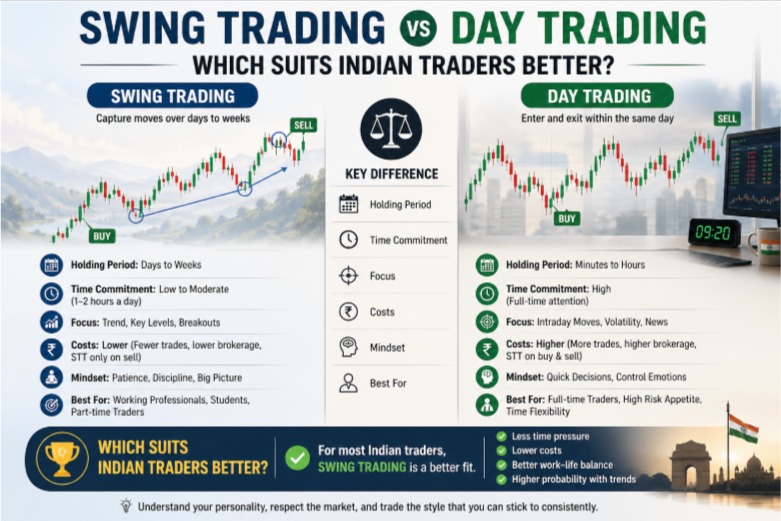
If you have ever had an all-night party watching Nifty futures or refreshed your trading screen a hundred times before lunch, you would have wondered, “Am I doing it right?” Swing trading vs day trading india is an old debate. Still, in recent years, it has become much more important for Indian retail traders following the blockbuster reports and regulations introduced by the Securities and Exchange Board of India (SEBI).
Key takeaway
- Swing trading is better for most Indian traders, as it’s less stressful, more flexible, and easier for those with work or education commitments.
- Day trading’s success rate is low—statistics indicate most Indian day traders lose money, particularly novices.
- Day trading is now more difficult due to regulations such as higher margin requirements, higher minimum capital, and lower leverage.
- Swing trading has a better risk-to-reward ratio due to fewer trades, lower costs, and more time to analyze.
- Discipline is key to success—not overtrading, using stop-losses, and sticking to a plan are more important than strategy.
What Is Day Trading and How Does It Work in India?
Intraday trading (also known as day trading) involves trading stock or derivatives within a day. Trades are closed out at the end of the session (3:30 PM IST). It’s risk-free as there is no overnight carry, but it’s not that easy.
In India, day trading is typically done in equity cash, equity futures and options (F&O), and currency derivatives. The brokers usually provide intraday leverage (also known as MIS margin), which varies from 3x to 5x, depending on the stock and broker. The aim is to make money out of a small intraday move with leverage.
What Is Swing Trading and Why Is It Different?
Swing trading involves holding a position for 2 days to a couple of weeks and profiting from a “swing” in the stock price. You aren’t looking to profit from a 0.3% intraday move on a stock—you are looking to profit from a 5%, 8%, or even a 15% move over a period of days.
Swing traders usually rely on a combination of technical (chart patterns, RSI, MACD, and moving averages) and occasional fundamental filters to find stocks that are moving. The biggest advantage? There’s no need to sit in front of your computer. After placing an order with a stop-loss and target, you can monitor the trades 2-3 times a day.
Day Trading Rules India: What You Must Know Before You Start

If you’re considering swing trading vs day trading, then the new day trading rules in India will be important—particularly after SEBI’s changes. Here’s the gist:
Margin & Leverage for Intraday
Upfront peak margin is required by SEBI. MIS (intraday) trades must be closed before market closure, or brokers may close them automatically—usually at a loss.
Larger F&O Contract Value (2024)
Index futures and options’ minimum contract value is now set at ₹15-20 lakh. This increases the amount of capital needed, making intraday trading of F&O contracts less feasible for retail traders.
Weekly Expiry Changes
The Nifty 50 is the only index that has weekly expiry. Indexes other than the Nifty 50, such as Bank Nifty, do not have weekly contracts, thus preventing high-risk speculative trades.
Intraday Position Monitoring (2025)
The exchanges now conduct multiple intraday position monitorings. This can lead to instantaneous action on any limit breaches (not just at close of day).
STT Impact on Frequent Trades
Securities Transaction Tax (STT) is still applicable. This can reduce the profits for frequent traders, particularly in options.
Day trading or swing trading which is better?
Limited Time for Monitoring
Working professionals can’t monitor the markets between 9:15 AM and 3:30 PM. So many favor swing trading with its ability to trade flexibly and monitor charts outside of normal trading hours.
Leverage Risk in Day Trading
Leverage in day trading is tempting but can lead to rapid losses. Given the large proportion of loss-making traders, leverage is typically more of a curse.
Better Decision-Making in Swing Trading
Swing trading allows more time to analyze trades. This helps to avoid rash trading, often seen with day trading.
Lower Transaction Costs
The reduced number of transactions leads to lower brokerage, taxes, and fees, making swing trading more cost-effective.
Swing Trading for Beginners India: Where to Actually Start

Start with Paper Trading
Trade for 30-60 days with paper money. Record trades, stops, and targets to get a strategy.
Learn Core Technical Analysis
Learn about support and resistance, trend lines, 20 & 50 EMA, RSI, and simple candlestick patterns. Don’t use too many indicators.
Use a stock screener.
Websites such as Chartink or Screener to filter out good stocks. Creating a watchlist vs following tips.
Set Risk Management
Define a stop-loss and try to have at least a 2:1 reward-to-risk ratio.
Trade Liquid Stocks
Trading Nifty 100 or Nifty 200 stocks will help in this regard.
Keep Position Size Small
Risk 2-5% of your capital for each trade. Don’t worry about making money.
Common Mistakes Indian Traders Make in Both Styles
Whether you are a swing trader vs day trader, these are mistakes that many make:
Overtrading Kills Profits
Frequent trading leads to more trading costs and errors. It doesn’t lead to more profits, just the opposite.
Ignoring Stop-Losses
It can be easy to lose money on losing trades. While small losses are acceptable, large losses need to be compensated by significant gains.
Following Social Media & Tips
Listening to tips from Telegram and YouTube can result in losses. By the time you see it, it’s too late.
Ignoring Taxes & Records
People ignore tax reporting such as ITR-3 for their F&O profits. Not maintaining records can lead to problems.
Trading Is Not Gambling
Trading without a plan, strategy, and discipline is not trading but gambling.
Conclusion
In swing trading vs day trading, swing trading is for most Indians, as it is convenient to their lifestyle and affordable, and decision-making. Day trading can only be done by full-time traders with discipline, money, and experience. Under the new day trading rules in India, it’s more difficult. Learn swing trading for beginners in India, practice, and only when you experience success (not media buzz) move to a more active trading strategy.
Not sure which is better, swing trading vs day trading? Sign up with InsightfulTrade and learn how to trade with time-tested strategies, minimize risk, and trade better with expert advice for Indian traders.
FAQs
- Is swing trading better than day trading for beginners in India?
Yes. Swing trading is less stressful, with fewer trades and more time to make decisions, making it better in the swing trading vs day trading debate for beginners.
- What are the key day trading rules in India?
3:30 PM square-off, obey peak margin, higher F&O margin (₹15-20 lakh), intraday monitoring, and business tax (ITR-3).
- How much capital is needed for swing trading in India?
You can start with ₹10k-₹20k, but it is better to start with ₹50k-₹1 lakh for diversification & risk management.
- Can I do swing trading with a full-time job?
Yes. Swing trading is suitable for professionals since it requires just 30-60 minutes per day for analysis and trading.
- Why do most day traders in India lose money?
Overtrading, high brokerage, emotional trading, no strategy, and the use of leverage.
Author: Arihant Jain
Trading Experience: 5+ Years
Arihant Jain is a financial markets analyst and trading educator with expertise in Forex, indices, crypto, and risk-managed trading systems. His insights are based on real trading experience, data-driven analysis, and transparent market understanding. All content is reviewed for accuracy and aligns with Google’s EEAT guidelines.
Risk Disclaimer:
Trading involves substantial risk. All information is for educational purposes only and should not be taken as financial advice. Always do your own research.