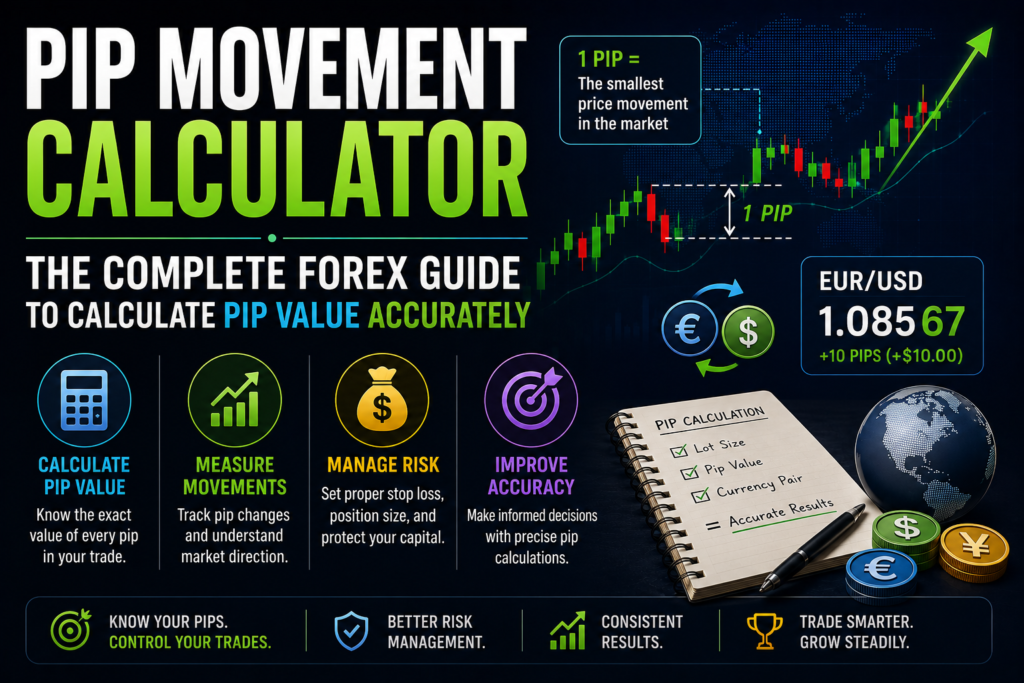

Forex trading may feel exciting, but unless one practices effective forex risk management, it can soon start to run into losses. Not sure what the actual forex risk management definition is or how the experts ensure their accounts? You have come to the right place. Here, we will deconstruct a viable forex risk management policy and see what features, such as a forex risk management calculator, can offer us, as well as demonstrate how shrewd traders can continue to be profitable regularly.
Key insights
- The success of trading is based on forex risk management—the strategies are the best, but cannot work in the long run without appropriate risk control.
- Adhere to risk rule (12) 1-2%—This is a mere rule that assists in averting significant losses on your account.
- An accurate calculation has to be done using a forex risk management calculator—it makes sure that it is sized correctly and eliminates conjecture.
- Have a high risk-to-reward ratio (1:2)—this will enable you to continue making a profit with the minimal amount of winning trades.
- Losses in control rather than preventing them—A sustainable trading strategy is characterized by small and regular losses.
- Secure initial capital—profits will be attained—Traders in the profession are aimed at survival and stability, and not fast profits.
What Is Forex Risk Management? (Forex Risk Management Meaning)
Forex risk management refers to the process of identifying, quantifying, and managing the financial risk on every trade you make in the foreign exchange market. It is not a single tool or rule but rather a framework that is comprehensive and regulates the amount of risk you take, how you get into and out of trades, and how you act when the market fails to play along with you.
1. What is the maximum amount that I can lose in this trade?
This is what your risk per trade is (usually 12%). A forex risk management calculator will assist you in establishing the right size of the position to take and not over-risking.
2. Which will be my point of departure in case of a trade failure?
Here is your stop-loss. A good forex risk management plan must provide an exit to all trades in order to ensure that there are limited losses.
3. Is it a reward for the risk?
Even average win rates provide a good setup with a good risk-reward ratio (such as 1:2) that is profitable in the long term.
How to Use a Forex Risk Management Calculator

A forex risk management calculator will help you to simplify position sizing without having to go by guesses or emotions. It makes all trades in accordance with your risk plan.
Inputs you need:
- Account balance (e.g., $10,000)
- Risk per trade (e.g., 1% = $100 max risk)
- Entry price (e.g., EUR/USD at 1.0900)
- Stop-loss price (e.g., 1.0850 — 50 pips)
- Pip value (1 standard lot of EUR/USD = 10/pip)
The calculation:
Position Size = Dollar Risk / (Stop Distance in Pips x Pips Value).
$100 ÷ (50 × $10) = 0.2 lots (20,000 units)
This informs you of the precise number of positions to have in order to keep the risk. You could have risked 1 lot of trading (5% of your account), but that is too high, just because you were trading one time.
The platforms such as Myfxbook, Investing.com, and MetaTrader have free forex risk management calculators and have built-in tools and expert advisors.
Why Forex Risk Management Is the Most Important Skill You Can Learn
Now, the reality before delving into strategies is that most of the trading materials are centered on entries and indicators, whereas forex risk management is considered secondary; however, it is the base.
Most ignored math of the traders:
- Lose 10% → Need 11.1% to recover
- Lose 25% → Need 33.3% to recover
- Lose 50% → Need 100% to break even
The losses are increased exponentially, which makes it more difficult to overcome in the future. This is the reason why traders who have a high rate of winning can fail in case their losses are excessive.
Trading Psychology: The Risk Management Tool Nobody Talks About Enough

All professional traders experience moments of indecision, panic, overconfidence, or vengeance trading in the wake of a loss. The disparity is that they possess mechanisms of fighting it.
Some of the psychological pitfalls are
- Overtrading: Making excessive trades due to boredom or to make a fast recovery.
- Moving stop-losses: In the hope that the market will reverse itself, rather than incur a loss.
- Averaging down a losing trade: To increase a losing trade, in essence, doubling down on an error.
Core Forex Risk Management Principles (Professional Summary)
- 1–2% Risk Rule
Never take a risk of over 1-2 percent of your trading capital at a time. This will prevent any huge drawdowns to your account and will cover you up to several losses.
- Stop-Loss Orders
Always have a stop-loss that will automatically get you out of losing trades. It restricts the destruction and defends capital. Depending on strategy, traders can use fixed, trailing, or volatility-based stop-losses.
- Risk-to-Reward Ratio
Take only trades in which you have a higher potential profit than risk, typically 1:2 or 1:3. This guarantees profitability in the long term despite having lower winning trades.
- Position Sizing
The size of the trade can be adjusted according to your risk and distance to stop loss. Sizing helps to make sure that no one trade can have a considerable negative impact on your account.
- Diversification & Correlation
Overexposure to similar currency pairs is to be avoided. A lot of foreign exchange pairs move in the same direction and therefore manage correlated trades.
- Margin Management
Leverage judiciously and maintain adequate free margin. Do not overload your account, particularly when there is high volatility news.
Building a Complete Forex Risk Management Plan
Step 1 – Set Risk Tolerance.
Determine the extent of loss you can take either weekly or monthly. In forex risk management, you establish limits in which you will quit trading when you reach them.
Step 2 – Establish Trade rules (Forex risk management plan)
Have strict guidelines: risk 1-2% of trade, a minimum 1:2 risk-to-reward, and a stop-loss should always be used.
Step 3 – Monitor all the trades.
Keep a trading journal to record each trade. This will assist in better management of your forex trading risk.
Step 4 – Review Performance
Check your results weekly or monthly to see mistakes and improve your forex risk management plan.
Step 5 – Stay Updated
Continue to read about the news and strategies in the market in order to enhance your forex risk management system.
Conclusion
Forex trading is not about being correct in all instances but about risk management in the correct manner. A good forex risk management policy, appropriate forex risk management, and good tools such as a forex risk management calculator can help you to safeguard your capital and trade with confidence. Be consistent, manage your losses, and think long-term; that is how professional traders make their way in the forex market.
Learn to take charge of your trades with InsightfulTrade—master forex risk management, develop a solid strategy, and apply intelligent tools to capitalize and grow steadily today.
Faqs
- What is forex risk management, and what is the importance of FX risk management?
Loss control is the way traders manage to control losses with the help of rules and strategies called forex risk management. It is significant, as any good strategy may go bust unless the risk is adequately managed, more so when leveraged.
- What do I do to develop a forex risk management policy for my trading?
Establish clear guidelines: risk per trade (1-2%), drawdown limits, position sizing, and leverage management. Do not forget to write and adhere to this forex risk management policy.
- Does it have a forex risk management calculator?
Yes, the majority of brokers and platforms have a forex risk management calculator, and tools like Myfxbook can assist you in calculating the position size by risk.
- Am I able to undertake a forex risk management course to know more?
Yes, a forex risk management course can assist you in learning position sizing, risk control, and sophisticated strategies. Select those courses that have real trading experience.
- What is the most prevalent error in forex risk management sense?
Over-trading—betting on a single trade. The amount that professionals tend to risk per trade to defend their account is 1-2 percent.
Author: Arihant Jain
Trading Experience: 5+ Years
Arihant Jain is a financial markets analyst and trading educator with expertise in Forex, indices, crypto, and risk-managed trading systems. His insights are based on real trading experience, data-driven analysis, and transparent market understanding. All content is reviewed for accuracy and aligns with Google’s EEAT guidelines.
Risk Disclaimer:
Trading involves substantial risk. All information is for educational purposes only and should not be taken as financial advice. Always do your own research.