If you’re an active trader, however, you do not need to know about the broker scalping rules as a luxury, but as a necessity. Each broker has their policies, and understanding them can help you avoid limitations with your account or get unpleasant surprises.
Scalping surveillance to surveillance of brokers, these regulations influence the speed at which you can make a transaction and limit what you can risk. In this guide, we are going to de-jumble all the aspects you need to know about the rules of broker scalping, and you can scalp comfortably without stumbling on the unseen limitations.Broker scalping rules are internal execution policies set by brokers to control how fast trades can be opened and closed on their platforms. These rules are designed to manage execution risk, system load, and price abuse. Enforcement is automated and based on execution behavior, not trader intent or profitability.
Quick summary
| Feature | What it means | Why it matters |
| Scalping Policy | Rules on whether scalping is allowed | Avoids penalties |
| Minimum Trade Time | How long a trade must stay open | Prevents flags |
| Trade Volume Limit | Max size for scalping traders | Reduces restrictions |
| Broker Surveillance | Brokers monitor fast trades | Protects accounts |
| Scalping Monitoring | Tools track trade speed and frequency | Helps stay compliant |
What Do Brokers Mean by “Scalping” in Practice?
Brokers define scalping based on execution behavior, not profit size. While definitions vary, most brokers monitor scalping activity using a combination of trade duration, frequency, volume, and execution patterns. In practice, scalping is flagged when trades are opened and closed within very short timeframes, executed repeatedly during low-latency conditions, or structured to exploit pricing delays.
Typical broker thresholds include:
- Trade duration: Positions closed under 30–120 seconds
- Trade frequency: Multiple rapid entries in the same instrument
- Execution behavior: Use of market orders during volatile price spikes
- Volume patterns: Repeated high-lot trades in short intervals
Understanding these internal definitions is critical, because brokers enforce scalping rules algorithmically, not manually.
What Are Broker Scalping Rules?
If you trade fast, you must know the broker scalping rules. Such are the rules that brokers establish with the trades that open and close within seconds or a few minutes.
Scalping is a lucrative business, yet brokers are very attentive to prevent excessive load on the system or any suspicious transactions.
Why can you never violate such Rules?
- No Suspension of the Account: Violate the rules and become involved, and your broker may suspend or even terminate your account. Nobody wants that mid-trade!
- Make the most Money: By playing by the rules, you are making a profit not only quickly but also safely and profitably.
- Be Open: Learn the policies of brokers and how they observe their actions, making you an even smarter trader, rather than a faster trader.

How Scalping Rules Differ by Broker Type
Not all brokers apply scalping rules the same way. The enforcement depends largely on how the broker executes trades.
- Market Maker Brokers
Often impose stricter scalping rules because trades are internalized. Very fast entries and exits can increase execution risk for the broker.
- ECN / STP Brokers
Usually allow scalping, but still monitor trade duration, order frequency, and latency abuse to protect liquidity providers.
- Hybrid Brokers
May allow scalping on specific account types while restricting it on others.
Common Broker Scalping Rules
Scalping is not taken seriously by all brokers; knowing the broker scalping rules keeps your dealings out of trouble.
- Minimum Holding Period: The trades should remain open within a specific period of time because too quick a trade is flagged.
- Trade Volume Limits: Brokers are allowed to limit the size of positions to minimize risk.
- Execution Rules: There can be restriction of some types of orders or a volatile period.
- Platform Compatibility: Ensuring that it has the capability of fast scalping strategies.
How Brokers Technically Detect Scalping Activity
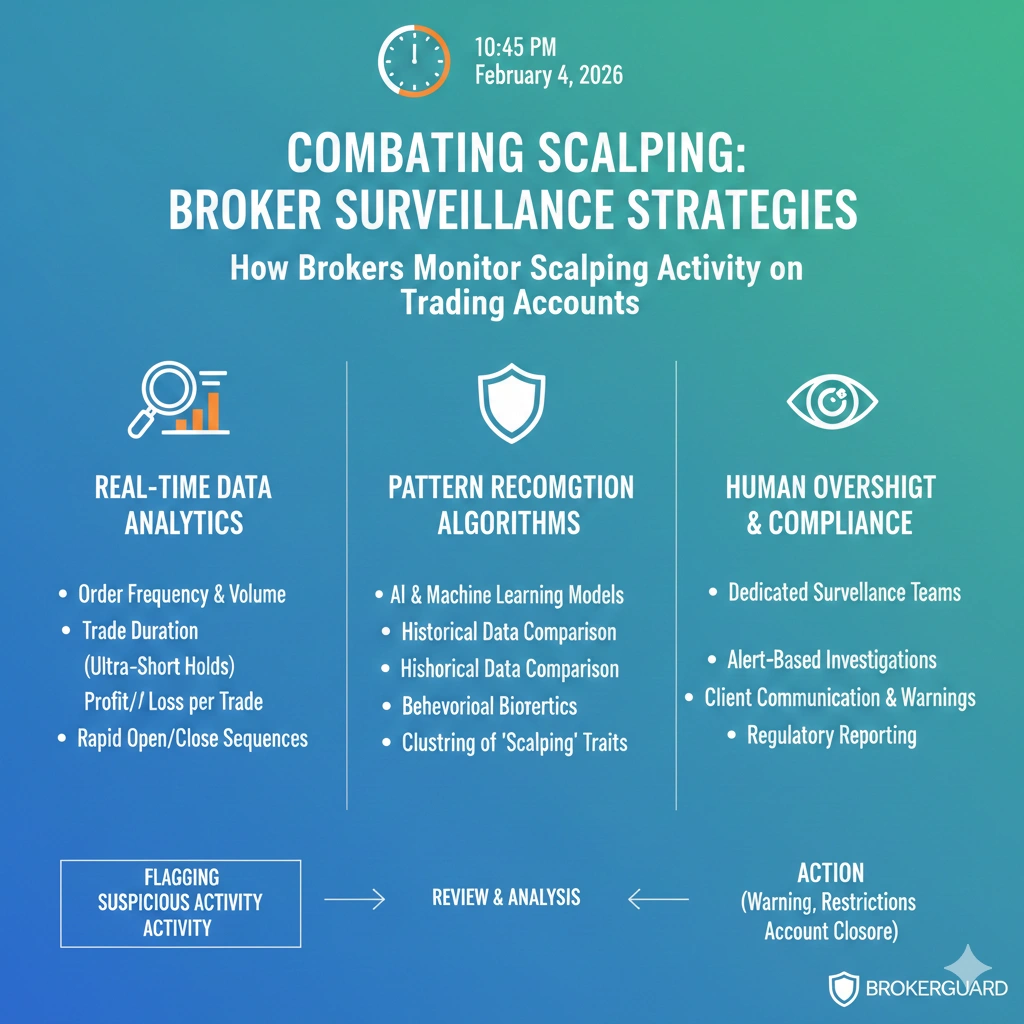
Brokers rely on automated surveillance systems to detect scalping behavior in real time. These systems analyze execution data rather than trader intent.
Common detection parameters include:
- Time-in-trade algorithms to flag ultra-short positions
- Order clustering analysis to detect repeated rapid entries
- Latency monitoring to identify arbitrage or price-feed exploitation
- Server-side execution logs comparing request vs fill timestamps
When patterns cross predefined thresholds, accounts may be flagged for review, restricted, or subjected to execution delays.
How to Check Scalping Rules Before Opening an Account
Traders should verify broker policies directly before using a scalping strategy. Key areas include:
Terms of Service → Trade execution clauses
Platform rules → Minimum trade duration
Account type details → Scalping restrictions
Support confirmation → Written clarification
Documenting these rules helps traders avoid disputes and provides evidence if execution issues arise.

Best Practices for Traders Following Broker Scalping Rules
- Read the Broker Scalping Policy: This is a policy; different brokers have various rules of operation- know them inside out.
- Use Compliance Tools: Auto notifications and scalping software will get you going.
- Test on Simulated Accounts: Test your strategy risk-free to ensure it is compliant with the rules of broker scalping.
- Be aware of Broker Surveillance: It is important to be aware of how brokers monitor trades to prevent violations.
- Keep Trading Records: document each trade with the aim of proving you were acting right and to optimize your approach.
Scalping Monitoring: Tools and Techniques
If you scalp, scalping has to be monitored. It assists you in keeping track of the broker scalping rules and prevents account problems.
- Trade Trackers: Automated: Use to track trade duration, size, and frequency.
- Platform Alerts: Receive warnings in real-time in case a trade is going to violate regulations.
- Broker Reports: Displays the types of trades that have been done and those that require action.
The importance of Scalping Monitoring.
- Protects you against being suspended or having your account.
- Secures all the trades according to the broker’s scalping.
- Assists you in polishing your plan and scaling in a more efficient way.
Having the correct scalping surveillance and knowledge of broker surveillance, you will be able to trade quickly, intelligently, and without worry.
Common Mistakes to Avoid
The most lighthearted traders may stumble even when they do not observe the rules of broker scalping. The following are the most frequent errors:
- Ignoring broker execution limits: Failing to read the rules may lead to the suspension of your account.
- The application of Prohibited Automated Systems: Some bots or EAs can break the regulations of scalping by brokers.
- Going over Maximum Trade Volume: Huge trades will occur outside the limits of the broker.
- Misconception of Minimum Trade Duration: It is too much of a risk to open and close trades at a very high rate.
How Does Broker Surveillance Impact Fast Traders?
In case you scalp, your trades are monitored by the broker so that you can be under the rules of broker scalping.
This is the effect it has on fast traders:
- Trade Tracking: All fast trades are tracked to make sure that they meet the scalping monitoring standards.
- Violation Alerts: Droids can send alerts based on suspicious patterns, such as repetitions of ultra-fast trades.
- Strategy of Broker Monitoring: With this knowledge, you are able to strategize safer, legal scalping plans.
- Account Safety: It is good to follow the rules and avoid suspensions, surprises, and punishments.
What Are the Risks of Ignoring Broker Scalping Rules?
It may be dangerous to disobey the laws in broker scalping.
- Suspension or Closure of an Account: Violate the regulations, and your broker may put a freeze on or close your account.
- Trade Rejections: There are trades that can be canceled automatically when they do not act according to the limits of scalping.
- Financial Losses: The unexpected punishment or denied trade can affect your profits.
- Strategy Disruption: breaking the law will mess up your scalping plan and make it less efficient.

Case Study: Account Suspension Due to Rule Violation
In 2025, a forex trader using an MT4 retail broker executed multiple trades that closed within 3–5 seconds each. The broker’s system flagged the account for violating its minimum execution time policy, which requires trades to remain open for at least 30 seconds.
The broker’s automated monitoring system detected repeated ultra-fast executions and temporarily restricted the account. After reviewing the broker’s scalping policy and adjusting trade duration, the trader complied with the rules, and the account was reinstated.
FAQs
What tools help with scalping monitoring?
The best tools are automated trade trackers, platform alerts, and reports given by the brokers.
How does broker surveillance impact traders?
Monitoring helps traders not to break the rules of scalping and avoid the suspension of accounts and fines.
Can I scalp on any broker platform?
Scalping does not work on every platform. Platform speed and check broker policy.
What happens if I violate the scalping rules?
It can be subject to loss of business through rejection of trade, suspension of accounts, or even closure.
How can I scalp safely?
Verify the policy of the check brokers, spy on the use of scalping, and learn about the monitoring of brokers. Demo test and log trades.
Conclusion
Understanding broker scalping rules is a must for anyone who trades fast. By ensuring that you have proper scalping surveillance and are aware that the brokers are being monitored, you can scalp without fear, ensure that your account is secure, and that you are maximizing profits. Violating the regulations may result in suspended accounts or active trades being denied; therefore, adhering is of the essence.
Check the policies of your broker always, monitor, and keep track of your trades. These actions will ensure that your scalping plan is safe, intelligent, and in accordance with the requirements of a broker.
At Insightful Trade, our goal is to explain broker execution rules clearly so traders understand how platforms operate, reduce compliance risks, and trade with confidence across different market conditions.
Author: Arihant Jain
Trading Experience: 5+ Years
Arihant Jain is a financial markets analyst and trading educator with expertise in Forex, indices, crypto, and risk-managed trading systems. His insights are based on real trading experience, data-driven analysis, and transparent market understanding. All content is reviewed for accuracy and aligns with Google’s EEAT guidelines.
Risk Disclaimer:
Trading involves substantial risk. All information is for educational purposes only and should not be taken as financial advice. Always do your own research.
Last Updated: 04 February 2026