

Quick Summary
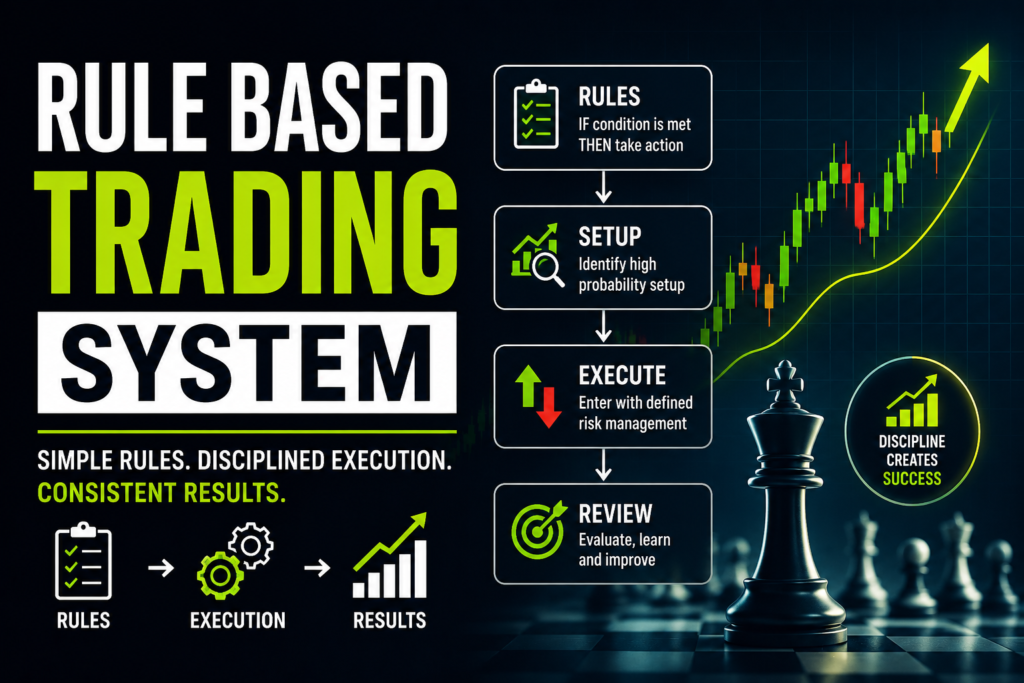
A lot of traders fail, not because their idea was bad but because they start making different choices the moment things get stressful. A rule based system fixes this by replacing those emotional decisions with a set plan. By using clear mechanical rules, you take the guesswork out of trading. In this blog, we’ll explain how these systems help you stay consistent, how you can avoid emotional mistakes, and how you can build a system that works in any market without having to guess what’s coming next.
Rule Based Trading System Overview Table
| Aspect | Discretionary Trading | Rule Based Trading System |
| Decision Process | Subjective | Predefined |
| Emotional Influence | High | Reduced |
| Execution Consistency | Variable | Stable |
| Learning Curve | Unstructured | Measurable |
| Mechanical Trading Rules | Minimal | Central |
The Core Problem: Why Traders Struggle With Consistency
Most traders know exactly what they should do but still struggle to do it every single time:
- Jumping into a trade too early
- Continuing a losing position past your stop loss
- Overtrading to get even after a loss
These aren’t technical problems; they’re emotional ones. A rule based trading system is designed specifically to close that gap between knowing the right move and actually making it.
Why Discretion Breaks Down Under Pressure
Making decisions can work when the market is quiet, but it usually falls apart when:
- When the market is wild
- Your losses starts to pile up
- Your confidence takes a hit
Therefore, having a set, mechanical rule will act like a stabilizer when things get stressful, making sure you do the same thing every time, no matter what you’re feeling.
What Is a Rule Based Trading System?
A rule based trading system is just a set of plans where
- Your entry rules are already set
- Your exit rule is crystal clear
- Your risk is decided before you start
Basically, all the big decisions are made before you enter into the trade, not while the price is moving.
Mechanical Trading Rules Explained
Mechanical trading rules are:
- Clear and objective
- Easy to test
- Repeatable
Examples include:
- “Buy when the price finishes above a specific level.”
- “Get out only when your stop loss or profit target is hit.”
- “Never risk more than 1% of your capital.”
The real power of these rules is that they are simple and clear, not that they are complicated.
Why Rules Matter More Than Market Views
Having the correct idea about the market won’t work if you don’t have rules to back it up. Without them you will end up:
- With bad timing
- Trade sizes too big for your account
- Closing out too early because you got nervous
A rule based system makes sure that even if your idea isn’t perfect, you still execute it with discipline.
Why Mechanical Trading Rules Reduce Emotional Errors
Rules stop you from having those stressful doubts like
- “Should I stay a bit longer?”
- “What if the price turns around?”
- “Maybe I should just add more money to this trade.”
A rule based system answers all of these before you even start, which cuts out a lot of second guessing and regrets.
Rule Based Trading System and Risk Management
Risk is where your rules matter the most; mechanical rules should clearly state:
- How much are you buying?
- The most you can lose in one trade
- The most you can lose in a single day
Without these rules, you are just reacting to problems after they happen instead of preventing them.
Hypothetical Example: Losing Streak Scenario
During a losing streak:
- Trading on emotions often start taking bigger rest to make it back
- While rule based traders just stick to the same plan
A set system keeps your losses under control and prevents you from doing something reckless.
Why Rules Improve Learning and Feedback
Rules give you real number to look at, like:
- How often you win
- Your average loss
- Your biggest dip in account balance
This lets you fix your strategy with logic and data, rather than just guessing based on how you feel.

Rule Based Trading System vs Over-Optimization
Well-designed mechanical trading rules are:
- Simple and easy to follow
- Tough enough to work in different markets
- Flexible enough to adapt
Rules that are too complicated usually fail because they only work in old data; simple rules are much more likely to last.
Mechanical Trading Rules in Different Market Conditions
Rules help traders
- Trade less when the market is quiet
- Lower your trade size when the market is wild
- Trade less during low volatility
A rule based system adjusts how you act without all the emotional drama.
Why Professionals Rely on Rule Based Systems
Professional traders have to be:
- Accountable for the money
- On top of their performance
- Careful with their risk
Mechanical rules make everything transparent and easy to repeat, which is important when you are trading a lot of money.
Tools That Support Rule Based Trading Systems
Useful tools include:
- Charting apps with alerts for your rules
- Software to test your ideas
- Trading journal to track your progress
These tools make your work easy and help you stay organised and systematic.
Common Misconceptions About Rule Based Trading Systems
- Rules make you too rigid
- Mechanical rules kill your creativity
- Rules are a guarantee that you will make money
- You only need rules If you are using a bot
- Rules are two hard for beginners
While the truth is, rules make you more consistent without taking away your ability to adapt in the market.
Long-Term Benefits of Mechanical Trading Rules
Over time, traders who stick to rules notice:
- They feel much less stressed
- It’s easier to see how the actually doing
- They are much better at protecting their money
The system becomes a way to help you make decisions, not something that holds you back.
Why Rules Do Not Remove Thinking
Rules handle the busy work of placing trades so that you can focus on:
- Studying the market
- Making your strategies better
- Evaluating your risk
A rule based system doesn’t replace your brain; it just helps you use it more effectively.
Conclusion
A rule based training system isn’t about getting rid of your intuitions; it’s about using intuitions before you put any money on the line. By sticking to a clear set of rules, you cut out emotional stress, stay consistent, and build a way that actually works for you. The market will always be unpredictable, but your rules give you a solid structure for how to handle the chaos.
Sites like InsightfulTrade focus on rules as a professional necessity, helping traders stop making impulsive choices and start following a reliable process. In the end, being consistent isn’t about guessing what is happening next; it’s about following your rules no matter what.
FAQs
1. What tools help implement a rule based trading system?
Charting platforms, backtesting software, and trade journals are commonly used.
2. Is a rule based trading system suitable for Indian traders?
Yes. It helps manage volatility, margin constraints, and regulatory risk.
3. Does SEBI regulate trading systems?
SEBI is mostly concerned with being honest and aware of risk, rather than telling you which specific trading rules to use.
4. Can beginners use mechanical trading rules?
Absolutely, in fact starting with rules is the best way for beginners to build discipline right from the start.
5. Are rule based trading systems only for automation?
No. Many discretionary traders use mechanical trading rules for execution.
Author: Kumkum Chandak
Experience: 3+ Years in Trading Research & Market Content Strategy
Kumkum Chandak is a trading content strategist and market research writer who specializes in simplifying technical analysis, trading tools, and strategy-driven educational content. Her work is optimized for EEAT, accuracy, and user intent, ensuring every article delivers practical insights for traders of all levels.
Risk Disclaimer:
All content is strictly educational and not financial advice. Trading involves substantial risk. Always perform your own analysis or consult a professional advisor.
Last Updated: 26 January 2026