
Quick Summary
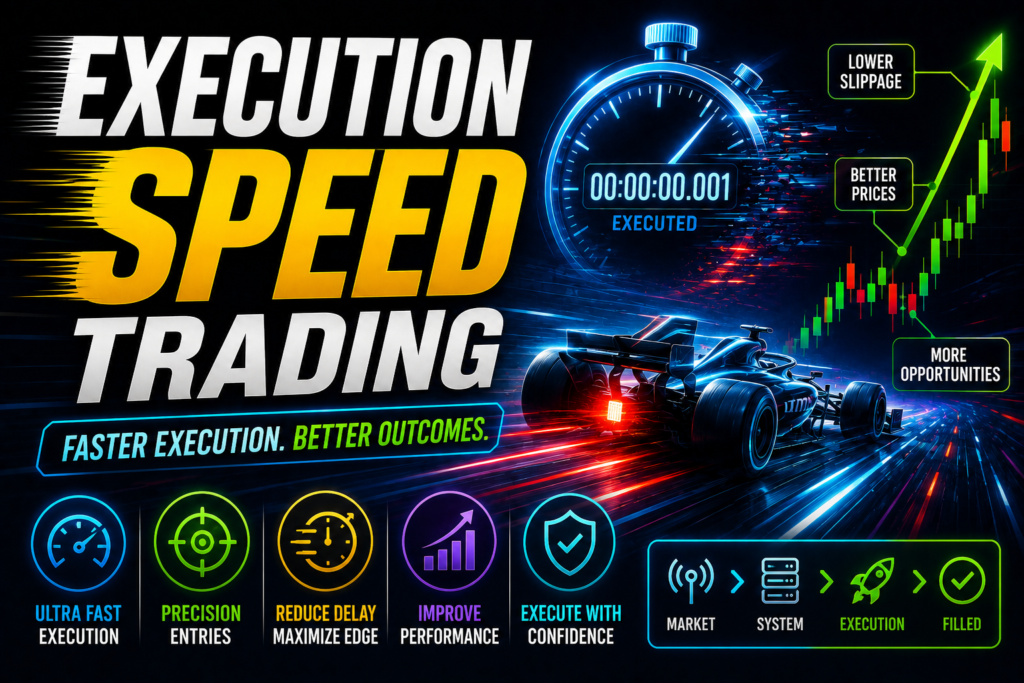
Your ability to succeed in trading hugely depends on your execution speed, especially when you are using leverage or trading quickly. Most people are so focused on finding the perfect entry and setups that they often forget how things like a broker’s tech or a slow connection can totally change their results. The markets like forex require immediate execution because their prices change at a very fast speed, so traders need to act right away. This blog will help you to pick the perfect broker and platforms, which will assist you in your trading journey.
Execution Speed Overview Table
| Factor | Slow Execution Environment | Execution Speed Trading Focus |
| Order Fill Time | Delayed | Near-instant |
| Slippage | Frequent | Reduced |
| Strategy Reliability | Inconsistent | Stable |
| News & Volatile Periods | High risk | Controlled risk |
| Broker Transparency | Low | High |
| Institutional Alignment | Weak | Strong |
The Core Problem: Why Traders Misjudge Performance
Most traders judge their performance based on
- Entry timing
- Indicator optimization
- Risk-reward ratios
- Backtest results
However, they completely ignore the actual thing, how their trade hits the market. A strategy that looks like a winner on a chart can easily fail in real life if execution speed is poor.
Why This Happens
When the execution is slow, it causes:
- Slippage goes beyond your planned risk
- Missed entries when the move starts
- Terrible fills when the market is wild
- Inconsistent results
This gap is exactly why paying attention to your execution speed is important.
What Is Execution Speed Trading?
Focusing on execution quality is all about setting up and running your trades with the major eye on:
- How fast your orders are processed
- The lag time between you and your broker’s server
- How efficiently your broker execute your trade
- How stable the platform stage when things get busy
It’s not a strategy; it’s just a way to measure the quality of your broker’s service and your tech setup.
Why Execution Speed Matters More in Forex
Decentralized Market Structure
Forex isn’t just one big exchange; prices are aggregated from multiple liquidity providers.
This means:
- Here price shaft in a blink of an eye
- Available trades can vanish in milliseconds
- Every broker has their own level of execution quality
In this kind of world, having fast execution is a necessity if you want to get the desired price you see on your screen.
Impact on Short-Term Strategies
Getting your execution quality right is a very important factor for:
- Scalping
- Trading the news
- Day trading momentums
- Automated or algo systems
In these cases, a delay of even a fraction of a second can make a difference between profit and loss.
Execution Speed Trading vs Strategy Optimization
A lot of traders spend months looking to get indicators and forming strategies but completely ignore how their broker actually fills their trades. Professionals perform tasks that are totally opposite:
- Confirm their execution tech before starting
- Access to liquidity
- Risk management
- Strategy logic
Because they know any strategy fails to deliver its intended results when its implementation does not achieve the required performance standards.
What Determines Execution Speed?
1. Broker Server Location
- Proximity to liquidity providers matters
- Data center choice impacts latency
2. Order Routing Model
- Straight Through Processing (STP)
- Electronic Communication Network (ECN)
- Hybrid models
Execution speed trading favors transparent routing over internal dealing.
3. Platform Architecture
- Order queue handling
- Platform stability during volatility
- API efficiency (for algo traders)
Fast execution in forex depends on platform-level engineering, not just spreads.
Slippage: The Hidden Cost in Execution Speed Trading
A lot of traders think getting a different price from their preferred one is bad luck. Your order processing speed along with present market conditions will determine what your final result will be.
- Slow speed increases the chance of slippage
- Faster speed helps you catch the price before it moves away
- Strong platforms stay steady even when the market is wild
The goal of order speed management involves risk management instead of attempting to eliminate all potential risks.
Fast Execution Forex and Algorithmic Trading
Algorithms magnify execution issues.
A backtest requires you to execute all trades at your desired price, but the actual market operates independently of your preferred rates.
Focusing on your trade speed ensures:
- Your algo catches the price it was looking for.
- The result stays closer to the planned one.
- You’ve lower risk of messy technical hiccups
Professional algo traders choose their brokers through order management systems instead of using fee structures to make their selection decisions.
Broker Transparency and Execution Speed
Brokers who are focused on fast order speed usually provide:
- Data on how long it takes to process a trade
- Reports showing if you got the price you wanted
- Clear house rules on how they handle orders
A broker who hides this information should be viewed as a warning sign about the quality of their server performance standards.

Tools That Support Execution Speed Trading
You can record the speed at which your trades are hitting the market by using:
- Your platform’s execution records.
- Tools that track slippage
- Monitoring the latency of your VPS
- The executions stats provided by your broker
The aim isn’t just to be the fastest but also to be consistent even when the market gets wild.
Common Mistakes Traders Make
- Selecting a broker because of low fees
- Ignoring the data that shows how your trades were filled
- Blaming your strategy when it’s actually your broker’s tech
- Trying to trade a high-speed strategies on slow platforms
- Assuming every broker handle the execution same
Trading for speed requires you to be very picky and carefully check out both both your broker and your platform
Why Fast Execution Forex Reflects Institutional Standards
The big player never tolerates:
- Random fills that don’t make any sense
- Delays during volatility
- Screen freezes
Regular traders from the same market often settle down with such clunky tech. But if you want consistency and profitability with proper strategies, execution quality becomes essential in trading.
Conclusion
Focusing on execution quality isn’t just about chasing every millisecond; it’s about making sure your strategy can actually survive in the real market. The speed at which you execute trades in Forex becomes essential because it helps you maintain risk control while preventing you from missing profitable trading opportunities.
By looking at your broker and platform through these execution-first lenses, you are trading with the same professionalism and discipline as a big player. If you want further information and want to check if your broker is holding you back, then connect with Insightful Trade for expert guidance on execution quality and platform performance.
FAQs
1. What tools help measure execution quality?
Most of the traders use execution logs, slippage trackers, or VPS latency tools to evaluate their performance.
2. Why is fast execution in forex important?
In Forex trading, price shifts within a blink of an eye because of how global liquidity works. That’s why speed is the only way to get into a trade at the price you want.
3. Is execution speed trading relevant for Indian traders?
Absolutely, Indian traders using legal instruments can really benefit from choosing a broker with better tech and tighter risk control.
4. Does SEBI regulate execution speed?
SEBI pushes fair and transparent execution in the markets, which makes high-quality execution an important part.
Author: Kumkum Chandak
Experience: 3+ Years in Trading Research & Market Content Strategy
Kumkum Chandak is a trading content strategist and market research writer who specializes in simplifying technical analysis, trading tools, and strategy-driven educational content. Her work is optimized for EEAT, accuracy, and user intent, ensuring every article delivers practical insights for traders of all levels.
Risk Disclaimer:
All content is strictly educational and not financial advice. Trading involves substantial risk. Always perform your own analysis or consult a professional advisor.
Last Updated: 21 January 2026