
Introduction
The business of trading on volatile markets is like the ride on a rollercoaster—the prices can soar up, an opportunity can be seen, and risks can multiply in seconds. That is why it is important to know the order types volatile markets that are correct in active markets. For both the EURUSD news spikes and the US30 news during the major events, the selection of the wrong order can result in lost profits or sudden losses.
Here in this guide, the best orders for high volatility—the market orders, limit orders, stop-limit orders, and OCO orders—are explained in a step-by-step manner. You will know how to get in and out of trades smarter, how to risk properly, and even how to recognize what is really going on in the market to polish up your trading ability. It is time to harness volatility and use it to your advantage, not against you.
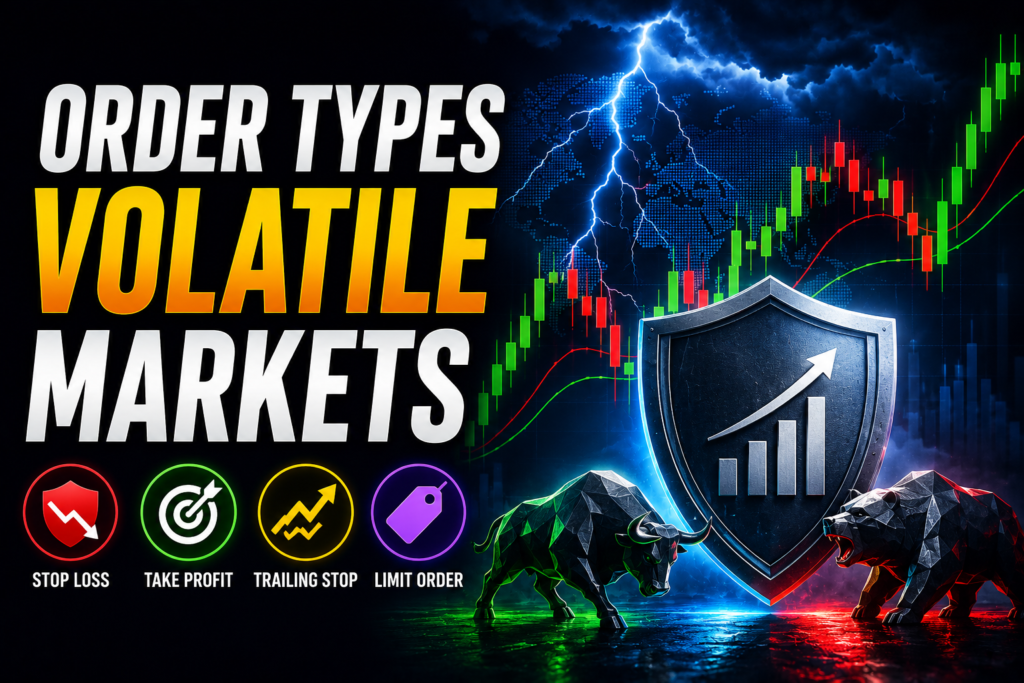
What Are Order Types Volatile Markets?
The volatile markets are not always easy to trade in, as the prices change rapidly and one misstep may cost you. This is one of the reasons why it is important to know the order types volatile markets.
- Market Orders: You are in a hurry; however, be careful of slippage when it is volatile.
- Limit Orders: Buy or sell at your price—one of the best orders to use when markets are very volatile.
- Stop Orders: Activate trades when they reach predetermined levels so as to control the risk or to control breakouts.
- OCO Orders: Two orders in one; one cancels out the other when one is executed—very useful in the face of the unexpected.
Pro Tip: When it is a volatile market, limit and stop-limit orders, as well as OCO orders, usually perform better than using market orders alone.
Why Are Volatile Markets Risky?
Volatile markets are rapid-paced—giant swings may strike your trades.
- EURUSD: 100–150 pips during NFP
- US30: 300+ points in an hour
In the order types volatile markets, with order types such as limit, stop-limit, or OCO orders, the risk and slippage are handled.
Trading tip: Check ATR or VIX ahead to determine market swings.
Which Order Types Protect You from Slippage?
The volatile markets experience slippage. These order types volatile markets, said:
| Order type | Pros | Cons |
| Limit Order | Executes at your price | Might not fill |
| Stop-Limit Order | Control price + trigger | May miss execution |
| OCO Order | Auto risk management | Slightly complex |
Example: To avoid buying at 1.1020 when the market spikes, you can put a limit buy of EURUSD at 1.1000 when the market is under news.
Pro Tip: When the market is volatile, it is often wiser to use limit, stop-limit, and OCO orders as opposed to a simple market order.
How Does a Market Order Perform in High Volatility?
Market orders are instant, but in volatile markets the price may rise rapidly.
EURUSD: 50-100 pip upward variations of spikes are possible.
US30: 200–300 points swing possible
Hint: Market orders should only be used when a volatile market has more importance on speed than price, such as when getting out of a losing trade.
Are Limit Orders Always Better in High Volatility?
Limit orders are useful to guard your price in the volatile market but might fail to trade where the prices are moving too quickly.
Scenario: A limit purchase at EURUSD 1.0980 may not be able to be filled in case of a sharp spike.
Hint: Place both limit and stop-limit orders to have greater coverage in the volatile market.
Pro Tip: Trade with the best orders with high volatility, such as a combination of limit and stop-limit orders, to remain in control without running after the market.
What Are Stop-Limit Orders, and When Should You Use Them?
A stop-limit order is ideal in volatile markets, as it allows you to control the exact price at at which you enter or leave.
Mechanism: Differentiate between a stop price and a limit price.
Scenario: the US30 is trading at 34,500, and you would like to buy as long as it goes to 34,450 and not below that. Stop = 34,450, Limit = 34,440.
Note: Stop limit orders are probably one of the best high-volatility orders, so one can avoid slippage and yet get opportunities.
How Can OCO Orders Improve Trading in Volatile Markets?
OCO orders are best in a volatile market, as you can get an opportunity to catch a breakout or reversal and not worry about making mistakes.
Example: EURUSD at 1.1050
- Buy stop at 1.1070 (upward breakout)
- Sell stop 1.1030 (downward breakout)
The order that is triggered first automatically cancels the other, and your trades are clean and your risk is managed.
Hint: OCO orders are the best orders for high volatility to be in control to avoid slippage.
Which Are the Best Orders for High Volatility?
Even in volatile markets, the correct choice of order type can spare you the slippage and tremendous losses. The most suitable orders when the volatility is high are
- Stop-Limit Orders: Have you in charge of the exact price.
- OCO orders: Automated entry and exit.
- Trailing Stops: Ride profits as the market rises.
Pro Tip: It is never too late to calculate the value of your pip and the amount of lot you have traded in order to control risk.
| Pair/Index | Pip Value per 1 Lot | Suggested Stop-Loss |
| EURUSD | $10 | 50–100 pips |
| US30 | $1 per point | 200–300 pips |
| GBPUSD | $10 | 70–120 pips |
How Do You Calculate Lot Size in Volatile Markets?
Risk management of volatile markets depends on knowing the correct lot size. You do not wish for a big swing to wipe out your account! Here’s a simple formula:
Lot Size = Account Risk % × Account Balance / Stop-Loss in Pips × Pip Value
Example:
- Account balance: $10,000
- Risk: 2% ($200)
- EURUSD stop-loss: 50 pips
- Pip value: $10
Lot Size = 200 / 50 × 10 = 0.4 lots
Can Technical Indicators Help Decide Order Type?
Absolutely! Technical indicators can also be used to inform the order types volatile markets:
- ATR (Average True Range):
This indicates the level of market movement, which can be used to establish a stop-loss.
- Bollinger Bands:
Mark’s breakout areas of limit or stop orders.
- VWAP:
Discloses the dynamics of the market during the day to either take a market or a limit order.

What Common Mistakes Do Traders Make in Volatile Markets?
- Trading market orders when the news is spiky can result in huge slippage.
- Stop-loss is set too restrictively and results in premature exits.
- Do not think about pip value and lot size, at your peril.
- Overleveraging in high volatility—in a flash you get wiped out.
FAQs
Q1: What are the safest order types volatile markets?
Stop-limit orders and OCO orders are relatively safer since they minimize slippage.
Q2: Can I use market orders during news events?
This is possible, technically, but prone to slip; lot sizes should be smaller.
Q3: How do I set stop-loss in volatile markets?
Calculate ATR, or historical volatility, in order to calculate a range.
Q4: Are OCO orders hard to use?
A little more complicated, yet only numerous platforms can be set up. Trading on demo accounts is beneficial.
Q5: What is the best order type for scalping volatile markets?
A combination of tight trailing stops, limit, or stop-limit orders.
Conclusion
It is thrilling to trade in volatile markets, but only when you employ the right types of order types volatile markets. High volatility orders, including limit orders, stop-limit orders, OCO orders, and trailing stops, are the best of all when it comes to controlling risk, preventing slippage, and profit lock-ins. Before entering trades, always do the calculation of your lot size and the value of pips, and check market indicators.
Using intelligent order types and risk management, you will be able to use market swings to your advantage instead of being defeated by them. It is worth remembering that preparation and correct order types volatile markets!
Join InsightfulTrade today to learn how to avoid slippage and how to protect your capital with expert strategies, real-time insights, and trader-friendly tools. Start trading smarter today!
Author: Arihant Jain
Trading Experience: 5+ Years
Arihant Jain is a financial markets analyst and trading educator with expertise in Forex, indices, crypto, and risk-managed trading systems. His insights are based on real trading experience, data-driven analysis, and transparent market understanding. All content is reviewed for accuracy and aligns with Google’s EEAT guidelines.
Risk Disclaimer:
Trading involves substantial risk. All information is for educational purposes only and should not be taken as financial advice. Always do your own research.
Last Updated: 10 January 2026