
Quick Summary
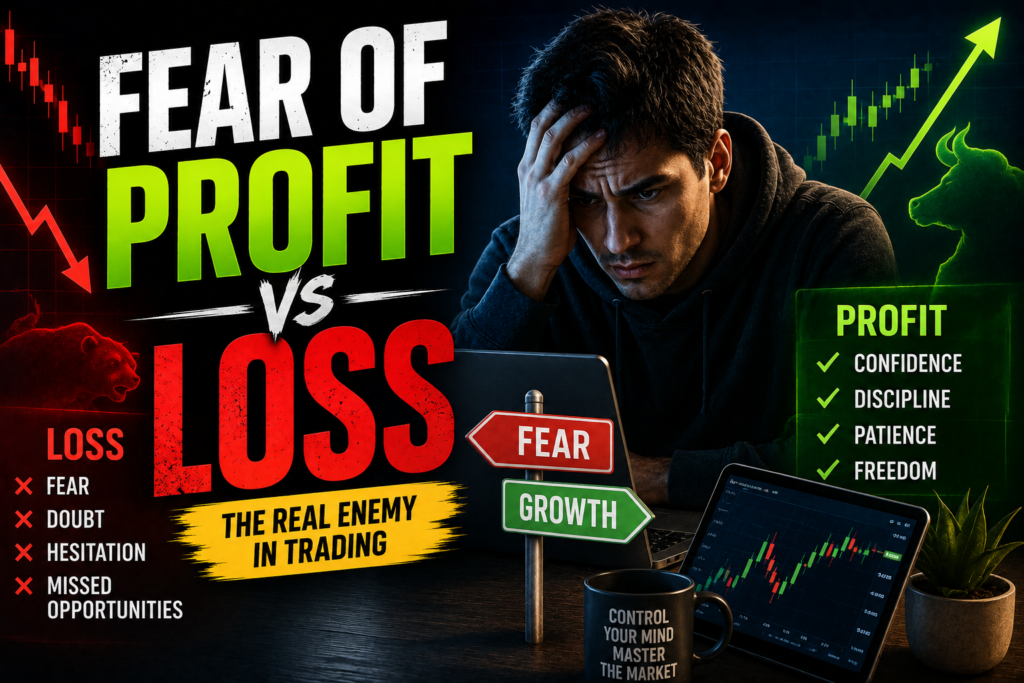
The fear of losing a profit while you’re still in a trade is something every trader feels. It happens when you get so anxious about the market taking back the profits that you exit a profitable trade too early. And the actual reason behind this feeling is not poor strategy, instead, it’s just your brain’s natural instinct to protect what is yours. In this blog, we’ll try to understand the real reason behind such feelings and how you can prevent them from causing your early exits.
| Aspect | Effect on Trading |
| Emotional State | Anxiety during profitable trades |
| Trade Execution | Premature exits |
| Risk–Reward | Skewed toward losses |
| Confidence | Gradual erosion |
| Long-Term Results | Inconsistent performance |
Understanding Fear of Profit Loss Trading
Fear of profit loss trading is a feeling that you get when your trade starts moving in your way. It’s a sudden pressure to jump and grab the profit right now, even when your original plan tells you to stay patient and wait for the bigger move.
But don’t worry or blame yourself for such thoughts; this isn’t because of lack of discipline. it’s actually your brain’s natural way of trying to protect you. It’s a psychological reflex designed to save you from the sting of watching a win turn into a loss.
Why Closing Trades Early Feels Safer
From a human perspective, clicking that close button feels like a huge win for your brain because:
- Converts uncertainty into certainty
- Reduces emotional tension
- Provides immediate relief
This habit is very hard to control. Because even when you know that as per your strategy you should stay in the trade, your brain is hardwired to prioritize feeling safe right now over a statistical win later. It’s choosing emotional comfort over the final scoreboard.
The Cost of Fear of Profit Loss Trading
Fear of profit loss trading does not just affect individual trades. It starts to weigh down your entire career over time.
Long-Term Consequences
- Reduced risk-to-reward ratios
- Lower system expectancy despite high win rates
- Emotional exhaustion from constant monitoring
- Loss of confidence in one’s trading plan
- Overtrading to compensate for missed profits
A trader who always closes trades early might look like they have great self-control, but they’re actually just acting out of pressure rather than trusting the number.
Practical Example: Closing Trades Early Psychology in Action
Imagine you’re trading NIFTY futures with a solid plan: you’re risking 10 points for a profit of 120 points.
- Trade moves +50 points quickly
- The Market pulls back 15 points
- Trader exits fearing profit loss
Result:
- Planned reward: 120 points
- Actual reward: 35 points
In records, it shows you have money. But if this process repeats for 100 trades, your strategy will eventually fail. Those tiny wins won’t be enough to cover your 60-point losses when they inevitably happen.
Why Fear of Profit Loss Trading Feels Logical (But Isn’t)
Your brain tries to convince you that exiting out early is the best option. It feels logical because:
- Profits are visible and real-time
- Market volatility is unpredictable
- You’re still feeling the fear of past reversals
But real success isn’t about feeling safe in the moment; it’s about trusting your instincts even when you are goodness is screaming at you to run.
The Core Misalignment
| Emotion | Reality |
| “I might lose these profits.” | Profits are not realized until exit |
| “The market looks risky now.” | Risk was already defined at entry |
| “Booking profit is smart.” | Inconsistent exits reduce expectancy |

The Role of Identity in Fear of Profit Loss Trading
Many traders do not realize that traders tie their self-worth to the trade outcomes.
When a winning trade becomes a smaller profit or just breaks even, it feels like a failure. The emotional identity attachment amplifies the fear of profit loss trading.
Professional traders keep these two things separate:
- Execution quality
- Outcome randomness
While most of the retail traders mix them together.
How Professionals Handle Fear of Profit Loss Trading
Professional traders also feel the nerves; they just build a system to handle them well.
Key Differences in Approach
- Predefined exits are non-negotiable
- Stop judging yourself on the bases of one trade
- Profit retracements are expected, not feared
- Focus remains on process
They realized that watching a price fluctuate is just a part of capturing larger moves.
Psychological Reframing Techniques
Reframe 1: Profits Are Not Yours Until Exit
Don’t get too attached to money that hasn’t been added to your account yet. It’s not yours until the trade is finished.
Reframe 2: Profit Zig-Zags Are Totally Normal
Just like how the price moves before you enter the trade, it’s going to move till you exit the trade.
Reframe 3: Your Job Is Execution, Not Prediction
Once you’re in a trade, you can’t predict anymore. Now your only job is to follow the plan.
Structural Solutions to Fear of Profit Loss Trading
Your mindset improves much faster when you have a solid plan than when you are just staying motivated.
Practical Methods
- Take partial profits
It calms your nerves and keeps you in the game for a bigger win. - Set a timer for exits
Instead of watching every prize moment, focus on the process. - Use automatic trailing stops
Use a preset rule to set your safety net; this helps avoid panic-driven choices. - Journal Emotional Triggers
Write down when you feel the fear of profit loss trading.
These tools work because they take the heavy lifting off your brain and put your system in charge.
Building Trust in the System
You can’t just wish for the strategy to work; for that you need to prove it to yourself with real data.
How to Build Evidence
- Backtest with realistic exits
- Forward test in small size
- Track expectancy, not just win rate
- Review missed profits objectively
This approach is all about relying on the experience and being transparent with your result to build true expertise.
Long-Term Mindset Shift
Trading is a numbers game. No single trade, whether it’s a big win or a small loss, actually defines how good you are.
The fear starts to fade away when you:
- Performance is judged over a series
- Rules replace impulses
- Identity is detached from outcomes
When you stop putting so much weight on one individual trade, that nervous itch to grab the money and run finally starts to disappear.
Conclusion
The fear of watching a profit vanish is one of the biggest mental hurdles you face in trading. It happens because we naturally want to protect what we have, even though that certainty of grabbing only a small win often hurts our result in the long run.
And the solution for this isn’t being mentally strong, but it’s about having a rock-solid plan. By using predefined stops and trusting the math instead of gut, you can trade with clarity. For further guidance you can always visit InsightfulTrade’s website. Here they focus on providing the best education and practical explanation for complex concepts to help both newbies and professionals.
FAQs
1. What tools help me stop panicking when I see a profit?
Keeping a solid trading journal, using automatic stop loss, and testing your strategies help you rely on the facts instead of your gut feelings.
2. Do other Indian traders also feel the rush of closing a trade early?
Yes. Between the wild market swings and high stakes here in India, it’s only natural to want to grab the money and run.
3. Are psychological tools SEBI-compliant in India?
Yes, using journals and learning apps is perfectly fine as long as they help you think better rather than just telling you what to buy.
4. Will this fear go away if I become more experienced?
It can, but time alone isn’t enough. It only gets easier when you actually look back at your data and commit to a set of rules.
Author: Kumkum Chandak
Experience: 3+ Years in Trading Research & Market Content Strategy
Kumkum Chandak is a trading content strategist and market research writer who specializes in simplifying technical analysis, trading tools, and strategy-driven educational content. Her work is optimized for EEAT, accuracy, and user intent, ensuring every article delivers practical insights for traders of all levels.
Risk Disclaimer:
All content is strictly educational and not financial advice. Trading involves substantial risk. Always perform your own analysis or consult a professional advisor.
Last Updated: 10 January 2026