

Introduction
Every forex trade lives or dies on a single unit of measurement: the pip. It is the heartbeat of the currency market — the smallest standardised move a pair makes, and the number that decides whether your position gained ₹250 or lost ₹2,500. Yet most traders, especially beginners in India, either misunderstand what a pip is worth or copy a formula that quietly gives the wrong answer for rupee pairs.
A pip movement calculator solves this. It converts a price change into money, in your own account currency, so you can size positions, set stop-losses, and manage risk with numbers instead of hope. This guide breaks down exactly how that calculation works, why the “pip” on India’s NSE is not the classic 0.0001 pip, and how to apply the maths to the pairs Indian residents are actually allowed to trade.
What Is a Pip in Forex?
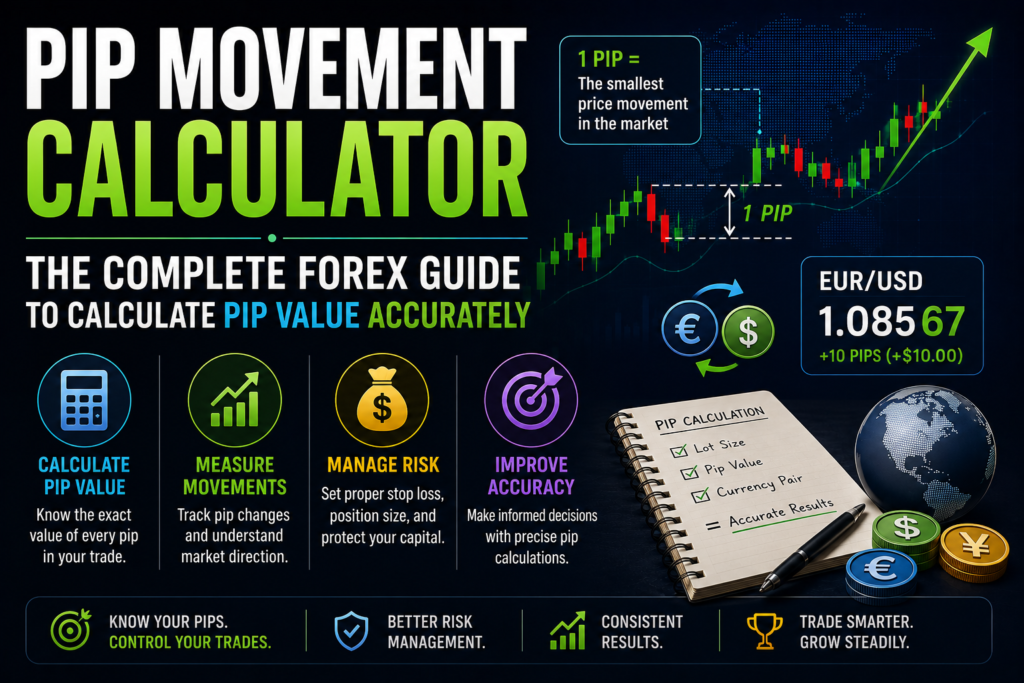
Quick answer: A pip (“percentage in point”) is the smallest standard price move in a currency pair. For most pairs it is the fourth decimal place (0.0001). For pairs quoted against the Japanese yen, it is the second decimal place (0.01). A pip movement calculator translates that tiny move into a money value.
If EUR/USD moves from 1.0850 to 1.0851, that one-digit change in the fourth decimal is one pip. If USD/JPY moves from 155.20 to 155.21, that is also one pip — just at the second decimal, because the yen is quoted differently.
Two related terms cause confusion:
- Pipette (fractional pip): one-tenth of a pip — the fifth decimal (or third for JPY pairs). Many platforms quote 1.08505, where the final “5” is a pipette.
- Point / tick: the smallest price increment an exchange allows. On the NSE this matters a lot, as you’ll see below, because the tick is not 0.0001.
Base currency vs quote currency
Every pair has two sides. In USD/INR = 95.80, the US dollar is the base currency (the thing being priced) and the Indian rupee is the quote currency (what it’s priced in). The rate tells you how many rupees one dollar costs. Pip value is always first expressed in the quote currency, then converted to your account currency if they differ.
What Is a Pip Movement Calculator?
A pip movement calculator is a simple tool (or formula) that answers one question: “If this pair moves X pips, how much money do I make or lose?”
It needs three inputs:
- The currency pair (which sets the pip size and quote currency)
- Your position size (in units, or in lots)
- The current exchange rate (needed only when the quote currency isn’t your account currency)
From those, it outputs the pip value — the cash change per one-pip move — and, multiplied by the number of pips, your total profit or loss.
The Pip Value Formula (Step by Step)
Here is the core formula, kept deliberately clean:
Pip value (in quote currency) = Pip size × Position size (units)
Pip value (in account currency) = Pip value (quote currency) × conversion rate to your account currency
Three scenarios cover almost every real trade.
Case A — Quote currency = your account currency
No conversion needed. This is the easiest case.
- Example (EUR/USD, USD account, 1 standard lot = 100,000 units): Pip value = 0.0001 × 100,000 = $10 per pip.
- Example (USD/INR, INR account): covered in the India section below, because the lot convention is different.
Case B — Base currency = your account currency
Divide by the exchange rate.
Pip value = (Pip size × units) ÷ exchange rate
- Example (USD/JPY, USD account, 100,000 units, rate ≈ 155): Pip value = (0.01 × 100,000) ÷ 155 = 1,000 ÷ 155 ≈ $6.45 per pip.
Case C — Neither currency is your account currency (cross pair)
Calculate the pip value in the quote currency, then convert it to your account currency using a bridging rate. The logic is identical to Case A followed by one currency conversion.
Lot sizes at a glance
| Lot type | Units of base currency | Pip value on a 0.0001 pip (quote-currency terms) |
|---|---|---|
| Standard lot | 100,000 | 10.00 |
| Mini lot | 10,000 | 1.00 |
| Micro lot | 1,000 | 0.10 |
| Nano lot | 100 | 0.01 |
Note: these global lot sizes apply to the international OTC market. India’s exchange-traded contracts use their own lot convention — see below.
Calculating Pip Value in India: The USD/INR Reality
This is where most generic guides mislead Indian readers. On the NSE currency derivatives segment, the mechanics are different from the global OTC market in two important ways.
1. The contract (lot) size is small. One USD/INR futures contract represents USD 1,000 of base currency — not 100,000.
2. The exchange’s minimum tick is 0.0025, not 0.0001. NSE quotes USD/INR to four decimal places, but the smallest permitted move is 0.0025 rupees. Many Indian brokers and educators call this 0.0025 tick “one pip,” which is where the confusion begins.
Let’s separate the two definitions cleanly so you’re never caught out:
| Definition | Move size | Cash change per NSE USD/INR lot ($1,000) |
|---|---|---|
| Global pip (0.0001) | 0.0001 | 1,000 × 0.0001 = ₹0.10 |
| NSE minimum tick (0.0025) | 0.0025 | 1,000 × 0.0025 = ₹2.50 |
So when a rate moves from ₹95.8000 to ₹95.8025, that is one NSE tick — a ₹2.50 change per lot. In global-pip terms, that same move is 2.5 pips. Both statements are correct; they just use different units. When a broker says “you make ₹2.50 per pip on USD/INR,” they mean per tick of 0.0025.
Worked example — a real USD/INR trade on NSE
Suppose you buy 10 lots of USD/INR futures at 95.8000 and the rate rises to 96.0500.
- Move = 96.0500 − 95.8000 = 0.2500 rupees = 100 ticks (0.2500 ÷ 0.0025)
- Value per tick per lot = ₹2.50
- Profit = 100 ticks × ₹2.50 × 10 lots = ₹2,500
If you prefer to think in global pips, the same 0.2500 move is 2,500 pips, and at ₹0.10 per pip per lot: 2,500 × ₹0.10 × 10 = ₹2,500. Same answer, different vocabulary — which is exactly why understanding both conventions protects you.
Cross-currency pairs on NSE
The NSE also lists exchange-traded futures and options on EUR/USD, GBP/USD and USD/JPY, with a lot size of 1,000 units of the base currency. The tick is 0.0001 for EUR/USD and GBP/USD, and 0.01 for USD/JPY. These are legal to trade because they are on a recognised Indian exchange — not because the offshore OTC versions are permitted.

Is Forex Trading Even Legal for Me in India?
This is a Your-Money-Your-Life question, so let’s be precise. Forex trading is legal in India, but conditionally. The framework comes from two regulators — the Reserve Bank of India (RBI) and the Securities and Exchange Board of India (SEBI) — under the Foreign Exchange Management Act (FEMA).
What is permitted for resident Indians:
- Trading currency derivatives (futures and options) on recognised Indian exchanges — NSE, BSE, and MSE.
- INR pairs: USD/INR, EUR/INR, GBP/INR, JPY/INR.
- The three exchange-listed cross pairs: EUR/USD, GBP/USD, USD/JPY.
What is prohibited:
- Trading spot forex or CFDs through offshore/unauthorised brokers.
- Sending margin money abroad to fund a foreign trading account — this is treated as an illegal capital outflow under FEMA.
- Using the Liberalised Remittance Scheme (LRS) to fund speculative forex margin trading.
The RBI publishes an “Alert List” of unauthorised electronic trading platforms, which it updates periodically. A quick red-flag test: any platform offering high leverage (100:1+), non-INR spot pairs to Indian retail users, or asking you to remit funds overseas is almost certainly outside the legal perimeter. Legitimate access runs through a SEBI-registered broker operating on an Indian exchange.
Bottom line: A pip movement calculator is a universal tool, but where you apply it matters. For Indian residents, apply it to exchange-traded INR and cross-currency derivatives through a SEBI-registered broker — not an offshore app.
Using Pip Value for Position Sizing and Risk
The real reason to master pip value isn’t curiosity — it’s risk control. A pip calculator lets you flip the equation: instead of asking “how much will I make,” ask “how many lots keep my risk inside my limit?”
The position-sizing formula:
Lots = (Account risk in ₹) ÷ (Stop-loss in ticks/pips × value per tick/pip per lot)
Example: You have ₹1,00,000 and follow a 1% risk rule, so your maximum loss per trade is ₹1,000. Your stop-loss on USD/INR is 40 ticks away. Value per tick per lot = ₹2.50.
- Lots = ₹1,000 ÷ (40 × ₹2.50) = 1,000 ÷ 100 = 10 lots
If your stop were wider — say 80 ticks — the same ₹1,000 risk budget would allow only 5 lots. This is the discipline professionals live by: the stop distance and the pip value determine your size, not the other way round.
Pros and Cons of Relying on a Pip Movement Calculator
| Advantages | Limitations |
|---|---|
| Removes mental-maths errors under pressure | Only as accurate as the rate/lot inputs you enter |
| Standardises risk across different pairs | Doesn’t account for spread, brokerage, or GST/charges |
| Makes position sizing objective and repeatable | Live rates move; a fixed input goes stale quickly |
| Works for INR pairs and cross pairs alike | Won’t tell you whether a trade is a good idea |
Common Mistakes When Calculating Pips
- Mixing up the pip and the tick on NSE. Assuming 0.0001 = ₹2.50 (it’s actually the 0.0025 tick that equals ₹2.50 per lot).
- Using 100,000-unit lots for NSE contracts. NSE USD/INR lots are 1,000 units.
- Forgetting the JPY exception. For any X/JPY pair, the pip is at the second decimal (0.01), not the fourth.
- Ignoring the account-currency conversion in Case B and Case C trades.
- Leaving out costs. Spread, brokerage, and statutory charges eat into the gross pip profit your calculator shows.
Myths vs Facts
| Myth | Fact |
|---|---|
| “One pip is always worth $10.” | Only for a standard lot on a pair where the quote currency equals your account currency (e.g., EUR/USD in a USD account). |
| “Forex is completely banned in India.” | It’s legal via exchange-traded INR and listed cross-currency derivatives on NSE/BSE/MSE. |
| “A pip and a tick are the same thing.” | Globally similar in spirit, but on NSE the tick (0.0025) is 2.5 global pips. |
| “You need offshore brokers for real forex.” | Offshore spot forex is prohibited for Indian residents; regulated derivatives exist domestically. |
Expert Analysis
The single most valuable habit a pip calculator instils is thinking in risk units, not price. Currency moves feel abstract — “the rupee slipped 25 paise” means little emotionally — but “that’s ₹2,500 across my 10 lots” is concrete and actionable. Professional desks size every position off a fixed fraction of capital precisely because pip value makes risk comparable across instruments that otherwise look nothing alike.
For Indian retail traders specifically, the terminology gap between the 0.0001 global pip and the 0.0025 NSE tick is where costly errors hide. A trader who mentally prices risk in “$10 per pip” habits from YouTube tutorials — most of which teach the OTC standard-lot model — will badly misjudge an NSE position that moves in ₹2.50 increments on 1,000-unit lots. Anchor your maths to the contract you are actually trading, and re-derive pip value from first principles rather than borrowing a number.
A final professional note on uncertainty: exchange rates, margins, and even lot conventions change. The USD/INR rate cited here (~₹95.8) reflects late-July 2026 levels and will drift; NSE and RBI periodically revise specifications and the Alert List. Treat any pip value as a snapshot, recalculate before sizing a live trade, and verify current contract specs on the NSE website and current rules on the RBI site.
Key Takeaways
- A pip is the smallest standard price move — 0.0001 for most pairs, 0.01 for JPY pairs.
- Pip value = pip size × position size, then convert to your account currency if needed.
- A standard lot (100,000 units) on a quote-currency-matched pair = $10 per pip; mini = $1; micro = $0.10.
- On NSE USD/INR futures, a lot is $1,000 and the minimum tick is 0.0025 = ₹2.50 per lot — often loosely called “one pip” in India.
- Use pip value to size positions from your risk limit, not the other way around.
- Indian residents may legally trade only exchange-traded INR pairs and listed cross pairs via SEBI-registered brokers; offshore spot forex violates FEMA.
- Any pip figure is a snapshot — recalculate with live rates before trading.
FAQs
1. What is a pip in forex? A pip is the smallest standard price change in a currency pair — the fourth decimal (0.0001) for most pairs, and the second decimal (0.01) for pairs quoted against the Japanese yen.
2. What does a pip movement calculator do? It converts a price move (in pips) into a money value in your account currency, using the pair, your position size, and the exchange rate.
3. How do I calculate pip value? Multiply the pip size by your position size (units) to get the value in the quote currency, then convert to your account currency if they differ.
4. How much is one pip worth on USD/INR at NSE? On a one-lot USD/INR futures contract (USD 1,000), a global 0.0001 pip is worth ₹0.10, and the NSE minimum tick of 0.0025 is worth ₹2.50 per lot.
5. Why do Indian brokers say ₹2.50 per pip? Because they treat the NSE minimum tick (0.0025) as “one pip.” In strict global terms that move is 2.5 pips, but the rupee value (₹2.50 per lot) is correct either way.
6. What is the difference between a pip and a pipette? A pipette is one-tenth of a pip — the fifth decimal place (or third for JPY pairs) shown on many trading platforms.
7. What is the difference between a pip and a tick? A pip is a fixed decimal convention; a tick is the smallest increment an exchange allows. On NSE USD/INR, the tick (0.0025) is larger than one pip (0.0001).
8. How much is a pip on a standard lot? On a pair where the quote currency matches your account currency, one pip on a standard lot (100,000 units) is worth 10 units of the quote currency — e.g., $10 for EUR/USD in a USD account.
9. How do I calculate pip value for USD/JPY? Pip value = (0.01 × units) ÷ the USD/JPY rate. For 100,000 units at a rate of 155, that’s about $6.45 per pip.
10. How do I use pip value for position sizing? Divide your rupee risk limit by (stop-loss distance in pips/ticks × pip value per lot) to get the number of lots you can trade.
11. Is forex trading legal in India? Yes, but only currency derivatives on recognised exchanges (NSE, BSE, MSE) in INR pairs and the listed cross pairs, through SEBI-registered brokers. Offshore spot forex is prohibited.
12. Which currency pairs can Indians legally trade? USD/INR, EUR/INR, GBP/INR, JPY/INR, plus the exchange-listed cross pairs EUR/USD, GBP/USD and USD/JPY.
13. Can I use international forex apps in India? No. Trading non-INR spot pairs via unauthorised offshore platforms or remitting margin abroad violates FEMA. Check the RBI Alert List before using any platform.
14. Does a pip calculator include spreads and brokerage? Usually not. It shows gross pip value; you must subtract spread, brokerage, and statutory charges to estimate net profit or loss.
15. Is the USD/INR pip value fixed? The per-tick rupee value per lot (₹2.50) is fixed by the contract, but when you convert values across pairs or currencies, the figure moves with live exchange rates.
16. How many pips is a “good” trade? There is no universal number — it depends on the pair’s volatility, your timeframe, and your risk-reward ratio. Judge trades by risk-reward, not pip count alone.
This article is for educational purposes only and does not constitute financial advice. Trading forex involves substantial risk — always do your own research before entering a position.