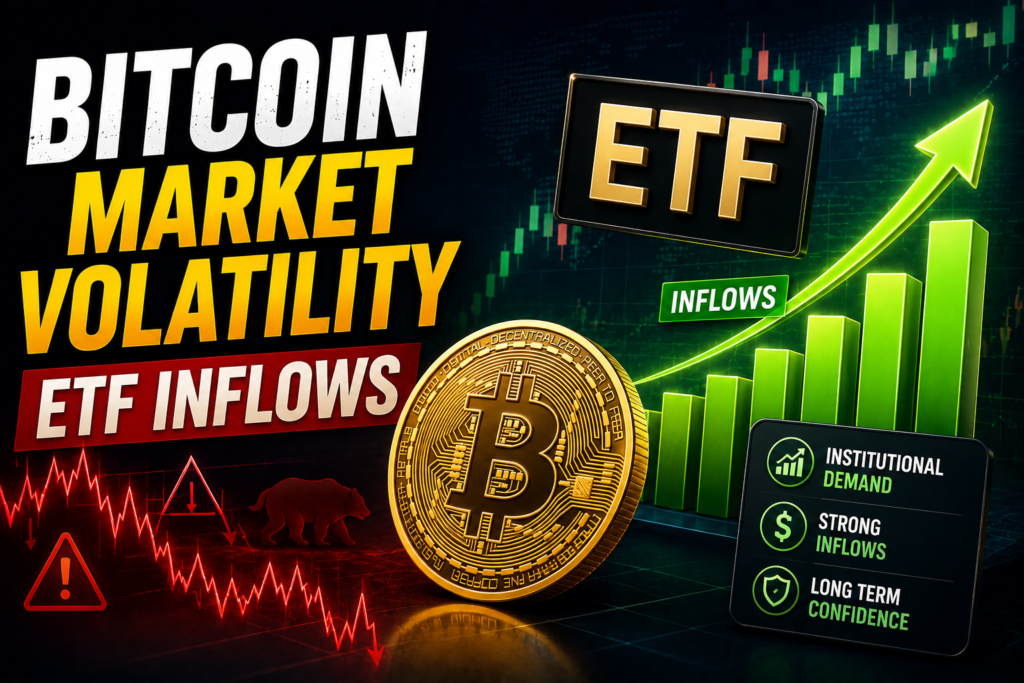

The crypto market is back in the spotlight. People are talking about Bitcoin price swings and a large amount of money flowing into ETFs. I notice Bitcoin is near a $92,000 to $93,000 resistance level. At that level the price is messy and unpredictable. Meanwhile, the big institutions just dumped nearly $697 million into Bitcoin ETFs in a single day, signaling that they’re betting big on the future.
This combination of price action and huge institution backing is changing how everyone feels about the market, everything from crypto to traditional forex trading. For anyone trading today, figuring out what is really happening behind the scenes and how to handle it is very important. In this blog we will understand bitcoin market volatility ETF inflows.
Introduction: Bitcoin Volatility Returns at a Critical Price Zone
Bitcoin has always been very volatile, but the way it’s moving currently is a bit different than what we have seen before. Instead of just being driven by the hype and regular people, the price is now being shaved by institutional funds and banks using spot ETFs to move capital.
As Bitcoin is trading near $92K–$93K, the market is at a decision point:
- Will it finally break through the resistance and continue climbing?
- Or will people booking their profits cause the price to stumble and pull back?
This uncertainty is what’s making the market so volatile, but for a trader, this uncertainty is exactly where the real opportunity lies.
What’s Driving Bitcoin Market Volatility ETF Inflows Right Now?
1. Major Resistance Around $92K–$93K
The $92,000–$93,000 is a big deal because it represents:
- A strong technical resistance zone
- A psychological round-number barrier
- An area where previous buying momentum has stalled
The price keeps trying to break this level, making the thing jumpy because:
- Short-term traders take profits.
- Sellers are trying hard to keep the price down.
- Breakout traders are aggressively betting on it.
The longer Bitcoin stays under the resistance level, the more it feels like a pressure cooker and when it finally breaks the move is usually huge.
2. Liquidity Clusters and Stop Hunts
When you see the price moving wildly around the key levels, it’s usually a signal that something deeper is happening. It often means:
- Stop-loss clusters above highs
- Heavy options positioning
- Leverage buildup in derivatives markets
The Big Banks and market professionals love when the market is volatile. During this time they nudge the price toward the cluster of orders just to get their own massive trades filled before the real move starts.
For traders: This market volatility near resistance isn’t just random noise; it’s the market getting its ducks in a row for a big move.
3. Macro Uncertainty Adds Fuel
The whole global market is keeping a close eye on:
- Interest rate expectations
- Inflation data
- Dollar strength
- Risk-on vs risk-off sentiment
Bitcoin is now tied directly to this macro-sensitive risk asset, swinging even harder whenever the global expectations shift.
Institutional Interest Behind Bitcoin Market Volatility ETF Inflows
One of the biggest reasons behind Bitcoin’s recent action is how the big institutions are now participating through ETFs.
$697 Million in a Single Day: What It Signals
Massive ETF inflows suggest:
- Growing institutional confidence in Bitcoin as an asset class
- Long-term capital entering the market, not speculative retail money
- Structural demand that can absorb selling pressure
Unlike retail traders, institutions:
- Buy systematically
- Allocate during dips
- Hold through volatility
This is fundamentally changing how Bitcoin behaves during pullbacks and breakouts.
How ETF Inflows Impact Price Action
When the big money is poured into ETFs, it acts like a shot of adrenaline for the market. It can:
- Create stronger support zones
- Reduce the depth of corrections
- Increase liquidity and volume
- Shift market sentiment bullish even during consolidations
However, they can also:
- Intensify volatility near resistance
- Attract short-term speculative traders
- Increase the speed of breakouts and breakdowns
Keeping an eye on whether the money is entering or leaving these ETFs is the best way to understand where the market is going next.

Technical Analysis Snapshot: Levels Traders Should Watch
Key Resistance Levels
- $92,000–$93,000: Immediate resistance
- $95,000: Breakout continuation zone
- $100,000: Psychological milestone if momentum accelerates
Key Support Levels
- $90,000: Short-term structural support
- $87,500–$88,000: Previous consolidation zone
- $84,000: Major support if volatility expands downward
When the Bitcoins match through $93K with a huge volume, it shows that the trend will keep going. But if it keeps getting rejected it can cause a retracement.
How Bitcoin Market Volatility Affects Trader Psychology
The mix of bitcoin market volatility ETF inflows can really mess with your head. It’s a total emotional rollercoaster, that challenges:
- Fear of missing out during breakouts
- Hesitation to enter after sharp moves
- Overtrading during consolidations
- Chasing momentum without confirmation
Professional traders focus on:
- Structure over emotion
- Confirmation over prediction
- Risk management over profits
At the end of the day the market rewards the person who stays disciplined, not the one who gets impatient.
What This Means for Forex & Crypto Traders
Bitcoin isn’t just doing its own thing anymore. It highly influences the market’s risk sentiment:
- Risk-sensitive forex pairs (AUD, NZD, emerging markets)
- The stock market
- Commodity-linked currencies
Key Correlations to Watch
- Strong Bitcoin rallies → risk-on behavior in forex
- Sharp BTC sell-offs → dollar strength and risk-off flows
- Volatility spikes → reduced leverage across markets
If you are trading more than just crypto, then you can use Bitcoin to predict the market’s mood. Especially with all that big ETF money involved now, it’s one of the best ways to tell if the global market is feeling confident or nervous.
Trading Strategies for the Current Market Environment
1. Trade With the Higher Timeframe Trend
- Align intraday trades with daily/weekly bias
- Avoid aggressive counter-trend positions near resistance
2. Adjust Risk for Volatility
- Use wider stop losses
- Reduce position size
- Avoid overleveraging during breakout attempts
3. Monitor ETF Flow Data
- Rising inflows = bullish bias
- Sudden outflows = caution signal
- Flat flows = range-bound conditions
4. Wait for Confirmation
- Break-and-hold above resistance
- Volume expansion
- Strong candle closes
In a market that is run by big institutions, getting confirmation is way more important than trying to be the fastest person in the trade.
Common Mistakes Traders Should Avoid
- Betting against the wrong move just because the price is too high
- Ignoring the ETF data and institutional money
- Getting impatient and overtrading during consolidation
- Letting your emotions run the show
I have seen the volatility turn into an opportunity, but it only works out when you are really prepared for it.
Conclusion: Key Takeaways for Traders
Now the bitcoin price swings and the flow of ETF money mark a time for the crypto market. I see that bitcoin is fighting near $92,000 to $93,000 and big investors are putting a lot of money into ETF inflows. Bitcoin and the crypto market are driven by long term money and not by short term hype.
Actionable Insights for Traders
- Watch ETF inflow trends daily
- Respect key resistance and support zones
- Trade with institutional momentum, not against it
- Prioritize risk management during volatility spikes
For further information or if you need guidance related to trading forex, you can visit Insightful Trade’s website. Here they provide expert traders guidance and well -researched educational content to help traders.
Frequently Asked Questions (FAQs)
1. Why is Bitcoin so volatile around $92K–$93K?
Because it’s a major resistance level where buyers and sellers are fighting for control.
2. What’s the deal with all the money flowing into Bitcoin ETFs?
It’s a sign that institutions and banks are actually getting serious. When you see these inflows, it means that they feel much more confident about where the market is heading.
3. Do ETF inflows push Bitcoin prices higher?
It does support the market, but it is enough to push the Bitcoin price. For a real breakout, we also need real buying volume for the price to reach $93k.
4. What are the most important levels that traders should watch right now?
Watch the resistance level at $93K and key support at $90K. To understand the market sentiment, it will tell us if Bitcoin is ready to soar or if it needs to take a breather.
5. Does Bitcoin volatility affect forex markets?
Yes, it influences risk sentiment and risk-on currencies.
Author: Kumkum Chandak
Experience: 3+ Years in Trading Research & Market Content Strategy
Kumkum Chandak is a trading content strategist and market research writer who specializes in simplifying technical analysis, trading tools, and strategy-driven educational content. Her work is optimized for EEAT, accuracy, and user intent, ensuring every article delivers practical insights for traders of all levels.
Risk Disclaimer:
All content is strictly educational and not financial advice. Trading involves substantial risk. Always perform your own analysis or consult a professional advisor.
Last Updated: 6 January 2026