
Quick Answer
International forex trading in India refers to trading global currency pairs like EUR/USD, GBP/USD, and USD/JPY through offshore brokers. Under FEMA 1999 and RBI regulations, Indian residents can only legally trade INR-based currency pairs on recognized Indian exchanges like NSE, BSE, and MCX-SX. Trading non-INR pairs via offshore forex brokers is in a regulatory grey area and carries legal and financial risk.

Introduction
One of the issues that nearly all traders are interested in is international forex trading in India. Whether you have ever thought about asking the question, is international forex trading legal in India, or is forex legal offshore to Indian traders? You are not alone. As the trade in international currency pairs such as EUR/USD and GBP/USD and even indexes such as US30 heightens its interest, an increasing number of Indian traders are looking to offshore markets in spite of the regulatory confusion. The problem? Rules of foreign brokers provided by the RBI are not always clearly written in simple language.
There are traders who get into it blindly and those who avoid it because of fear. We will deconstruct the workings of international forex trading in India, what is legal, what is risky, and what every trader in India needs to know before trading internationally—no jargon, just real talk.
What Is International Forex Trading in India?
International forex trading in India is the trading of international currency pairs in foreign or offshore brokers as opposed to Indian exchanges. Common Indian forex pair participations by Indian traders include:
- EUR/USD
- GBP/USD
- USD/JPY
International forex trading differs from domestic trading primarily in the instruments available, leverage offered, and the regulatory body overseeing the platform. While Indian exchanges offer currency derivatives in INR pairs under SEBI oversight, offshore platforms operate outside this framework entirely.
Coupled with forex, global indices, including the US30 (Dow Jones), NASDAQ, and DAX, are other indices that are traded by many traders on offshore platforms. Nonetheless, in India, international forex trading is a complex issue due to FEMA regulations and RBI policies on foreign brokers that limit the way Indian inhabitants can legitimately explore such markets.
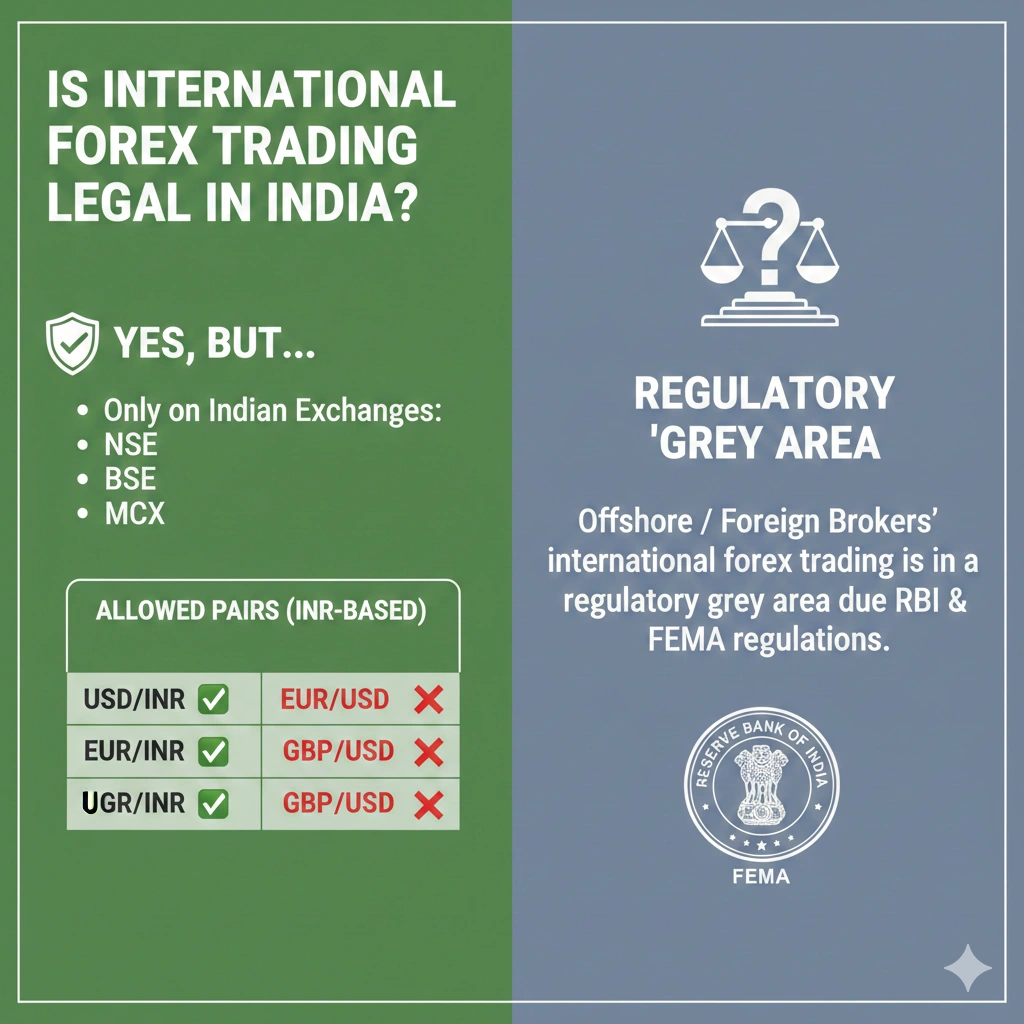
Is International Forex Trading Legal in India?
The Reserve Bank of India (RBI) established that Indian residents can only trade in forex in established Indian exchanges, like:
- NSE
- BSE
- MCX
Even that, just in INR-based currency pairs, i.e.,
| Allowed pair | Status |
| USD/INR | ✅ |
| EUR/INR | ✅ |
| GBP/INR | ✅ |
| EUR/USD | ❌ |
| GBP/USD | ❌ |
Thus, although forex trading is legal, the offshore or foreign brokers’ international forex trading in India is in a regulatory grey area, as per the RBI regulations on foreign brokers and FEMA regulations.
Is Forex Legal Offshore for Indian Traders?
The question, most times posed by many Indian traders, is whether forex is legal offshore. In India, international forex trading in the grey area is technically not allowed through FEMA. RBI regulations about foreign brokers are a primary source of the confusion because they do not cover the offshore platforms.
- The Indian residents are not permitted to engage in offshore forex trading.
- RBI does not regulate foreign brokers.
- Offshore platforms are at risk of traders.
What Is FEMA 1999 and How Does It Affect Forex Traders?
The Foreign Exchange Management Act (FEMA) 1999 is the primary law governing all foreign exchange transactions for Indian residents. It replaced the older FERA (Foreign Exchange Regulation Act). Unlike FERA which treated violations as criminal offenses, FEMA treats violations as civil/regulatory offenses — but penalties are still severe, up to 3x the amount involved.
Key FEMA restrictions for forex traders:
- You cannot remit funds abroad for speculative forex margin trading
- The Liberalised Remittance Scheme (LRS) — which allows up to $250,000 per year in foreign remittances — does not permit forex speculation
- Using LRS funds to fund an offshore forex account is a direct FEMA violation
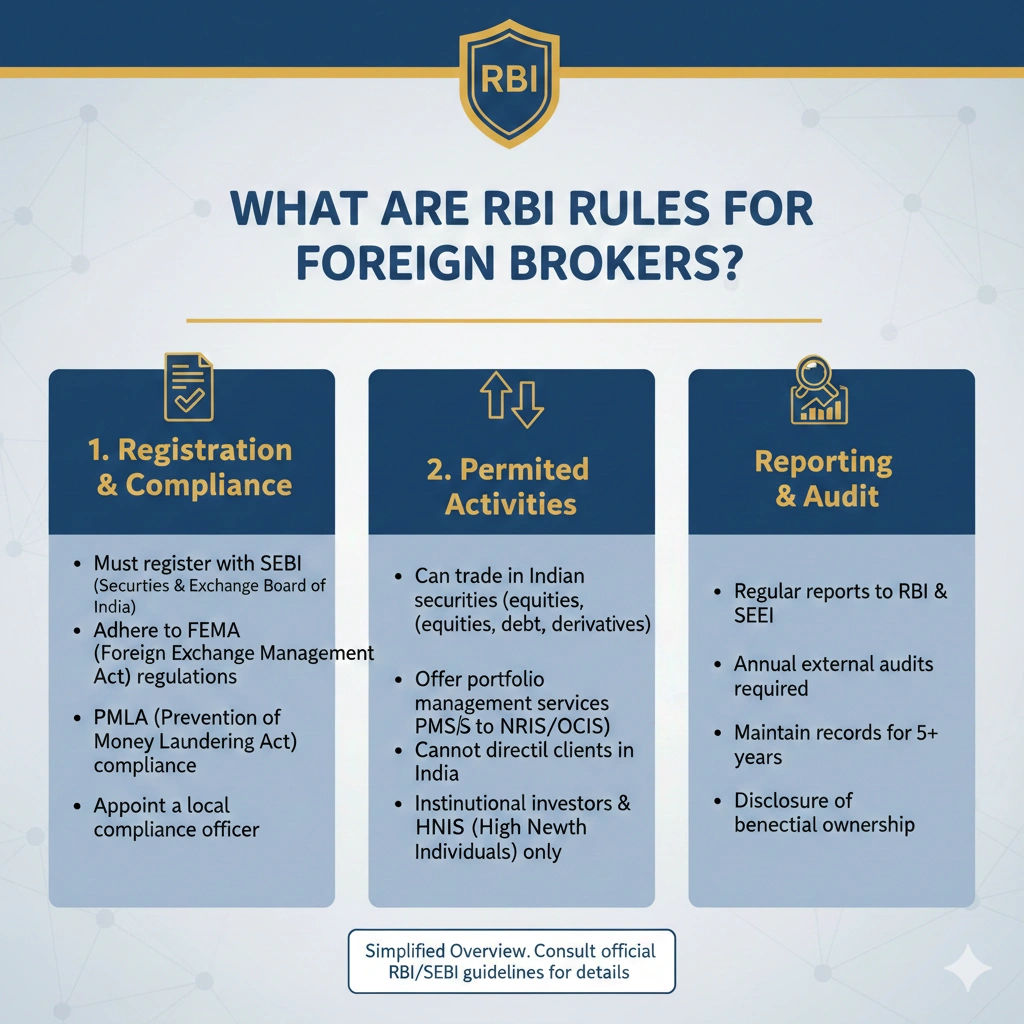
What Are RBI Rules for Foreign Brokers?
In the matter of international forex trading in India, the RBI rules for foreign brokers of RBI are quite clear, yet misunderstood. The legislation of the RBI does not permit foreign or offshore forex brokers to legally conduct their businesses and sell their services to residents of India. Due to FEMA and remittance limits, trading with offshore brokers places traders in a grey area of regulation.
- The FEMA Act limits the capital account operations.
- LRS does not permit forex speculative trade.
- Foreign brokers are not licensed by the RBI.
- Indian traders had no legal safeguards in case of litigation.
The RBI Alert List — Brokers Indian Traders Must Avoid
The RBI Alert List (also called the RBI Red List) is a publicly available list of offshore brokers and platforms that are not authorized under FEMA to offer forex services to Indian residents. As of late 2025, this list contains nearly 100 entities, including globally popular names. Trading with brokers on this list is a technical FEMA violation.
Always check the RBI Alert List at rbi.org.in before using any offshore platform.
You can verify broker authorization status directly on the RBI official website
Why Do Indian Traders Still Trade International Forex?
Although the legalities are confusing, international forex trading in India attracts a number of traders, as offshore platforms have increased leverage and exposure to international markets. Although RBI rules for foreign brokers provide a grey area, traders risk it to provide more flexibility and possibilities.
Advantages
- Greater leverage than the Indian exchanges.
- Trade in international tools such as US30, NASDAQ, and gold.
- 24×5 market availability
- Generally tighter spreads
Disadvantages
- Uncertainty regarding FEMA in the law.
- No RBI or SEBI protection
- The potential exit risk and safety of funds.
- The trading is on a personal basis.
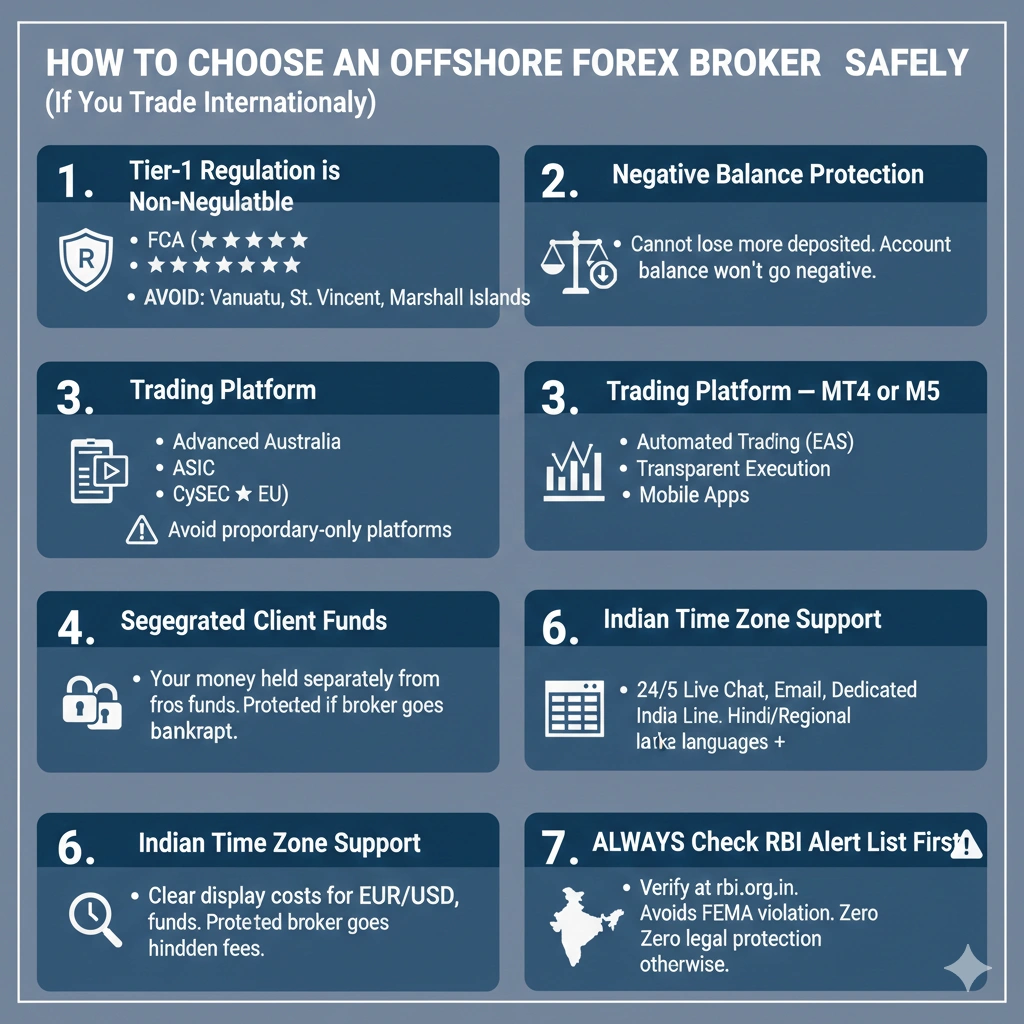
How to Choose an Offshore Forex Broker Safely (If You Trade Internationally)
If you are exploring international forex trading in India, choosing the right broker is the most critical decision you will make. Not all offshore brokers are equal — and the wrong choice can cost you your entire capital with zero legal recourse in India.
Here is what every Indian trader must verify before depositing a single rupee:
1. Tier-1 Regulation is Non-Negotiable
Always choose a broker regulated by a top-tier financial authority. The three most trusted regulators for Indian traders are:
| Regulator | Country | Trust Level |
|---|---|---|
| FCA (Financial Conduct Authority) | UK | ⭐⭐⭐⭐⭐ |
| ASIC (Australian Securities and Investments Commission) | Australia | ⭐⭐⭐⭐⭐ |
| CySEC (Cyprus Securities and Exchange Commission) | EU | ⭐⭐⭐⭐ |
An FCA regulated forex broker or ASIC regulated broker India traders use will have strict capital requirements, regular audits, and client compensation schemes. Avoid brokers registered only in Vanuatu, St. Vincent, or the Marshall Islands — these are low-accountability jurisdictions with virtually no trader protection.
2. Negative Balance Protection
Negative balance protection ensures that even during extreme market volatility — like a flash crash or major news event — you cannot lose more money than you have deposited. Without this, your account balance can go negative and you may legally owe money to the broker. This is a mandatory feature for any safe offshore forex broker Indian traders should consider.
3. Trading Platform — MT4 or MT5
Only use brokers that offer MetaTrader 4 India or MetaTrader 5 India access. These are the global industry standard platforms with:
- Advanced charting tools
- Automated trading (Expert Advisors)
- Transparent order execution logs
- Mobile trading apps
Brokers with proprietary-only platforms are harder to verify for execution quality and are often a red flag.
4. Segregated Client Funds
Segregated client funds means the broker legally keeps your deposited money in a separate bank account from their own operational funds. If the broker goes bankrupt, your funds are protected and cannot be used to pay the broker’s debts. Always confirm this is explicitly stated in the broker’s terms and conditions.
5. Transparent Spreads and Swap Rates
Before opening an account, check the broker’s published spread and overnight swap rates for the pairs you plan to trade — especially EUR/USD, GBP/USD, and indices like US30. Hidden costs in spreads and swaps silently drain profitability over time. A trustworthy broker displays all fees clearly on their website.
6. Indian Time Zone Support
Offshore forex broker safety also means having access to responsive customer support during Indian trading hours (IST). Look for brokers offering 24/5 live chat, email support, and ideally a dedicated India support line. Language support in Hindi or regional languages is an added advantage.
7. Always Check the RBI Alert List First
Before registering with any offshore broker, cross-check their name against the RBI Alert List — the official list of unauthorized entities prohibited from offering forex services to Indian residents.
Trading with a broker on the RBI Alert List is a direct FEMA violation and leaves you with zero legal protection if your funds are frozen or withdrawn.
Forex Trading Tax in India — What You Must Know
Forex trading profits in India are taxable. Here is how the Indian tax system treats international forex trading:
| Tax Category | Rate |
|---|---|
| Speculative Business Income (Forex) | 30% + 4% cess |
| TDS on forex transactions above ₹7 lakh | 5% |
| GST on brokerage charges | 18% |
| Advance tax threshold | If liability > ₹10,000 |
- Forex income must be reported in ITR-3 or ITR-4
- Forex trading losses can only be offset against speculative income, not other income
- Maintain records of all trades for at least 7 years for potential RBI audit
- Tax Collected at Source (TCS): 5% on large foreign remittances under LRS
What Is the Difference Between Indian Forex and International Forex?
Market access is the primary distinction between the Indian forex and international forex trading in India. Indian forex is traded on the basis of RBI and limited to INR pairs, and international forex uses international currency pairs and leverages offshore brokers, which is governed by RBI rules for foreign brokers.
| Feature | Indian Forex | International Forex |
|---|---|---|
| Pairs | INR-based only | All global pairs |
| Leverage | Up to 1:5 (SEBI limit) | Up to 1:500 (offshore) |
| Regulation | RBI / SEBI | FCA / ASIC / CySEC |
| Legal Status | Fully legal | Regulatory grey area |
| Tax Reporting | ITR-3/ITR-4 | ITR-3/ITR-4 |
| Investor Protection | SEBI protected | None in India |
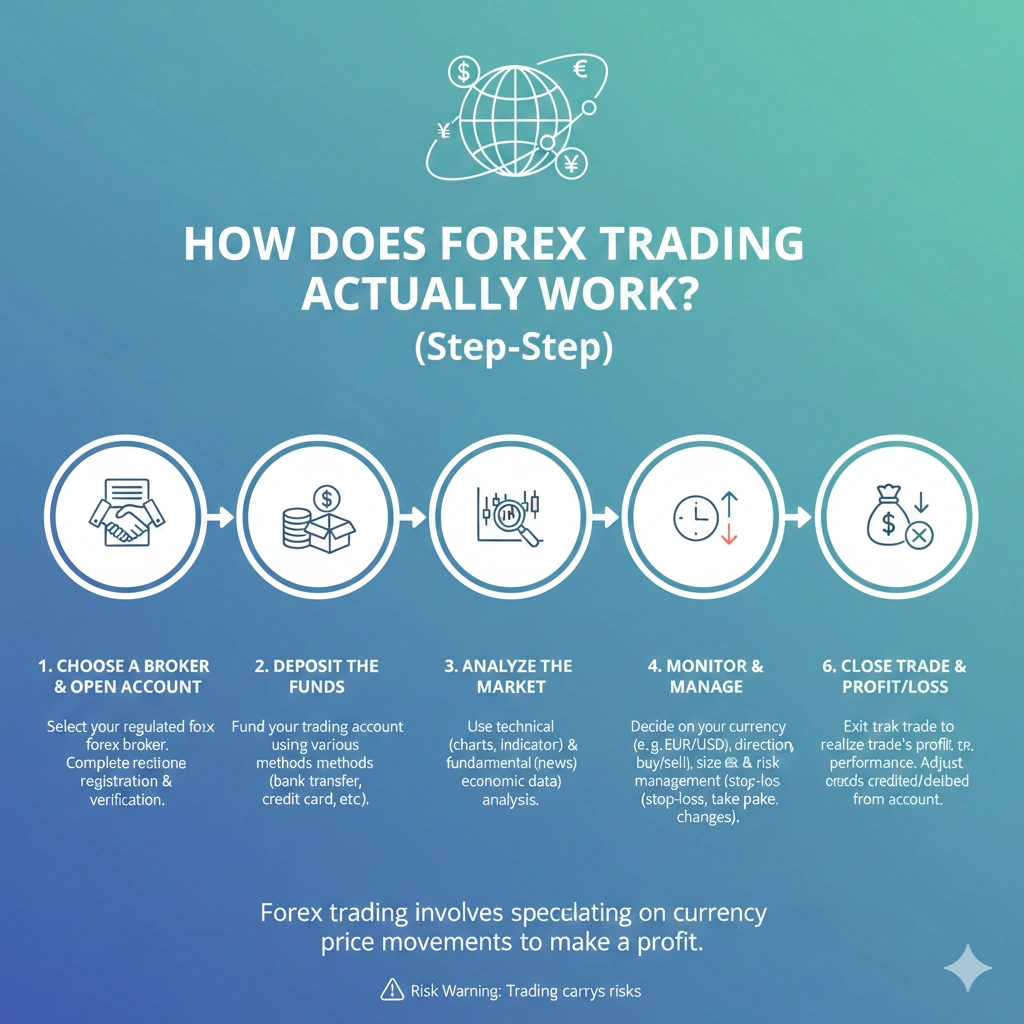
How Does Forex Trading Actually Work? (Step-by-Step)
However, forex trading is very easy, even in the case of international forex trading in India. You pick a pair of currencies, such as EUR/USD, and select your lot size, and your gain or loss will be based on the number of pips that the market moves.
Step 1: Choose a Currency Pair
Example: EUR/USD
Step 2: Decide Lot Size
| Lot type | Units | Pip value |
| Micro | 1,000 | $0.10 |
| Mini | 10,000 | $1 |
| Standard | 100,000 | $10 |
Step 3: Markets Movement Excerpt.
- Buy EUR/USD at 1.1000
- Sell at 1.1050
- Movement = 50 pips
- Profit on 1 mini lot = $50
Real Trading Example: EURUSD Trade Breakdown
An example of this in the real world market is common in the international forex trade India, where traders seek clean trend continuation setups on a major pair such as EURUSD.
The real market example of the scenario is as follows:
- Pair: EURUSD
- Timeframe: H1
- Trading plan: Trend following.
- Entry: 1.0870
- Stop Loss: 1.0830
- Target: 1.0950
Outcome:
The trade yielded +80 pips within 2 days and this was largely due to the fact that the US dollar weakened following the US CPI data.
How Do Traders Trade Indices Like US30 from India?
The international forex trading in India also includes many Indian traders who engage in trading global indices such as US30 (Dow Jones). These markets are accessible through offshore brokers to allow traders to make money through the fluctuations of the leading US indices.
US30 Example:
- Buy at 38,000
- Sell at 38,150
- Points gained = 150
- Profit varies in terms of lot size (depending on the broker).
High Volatility—the reward and risk are high.
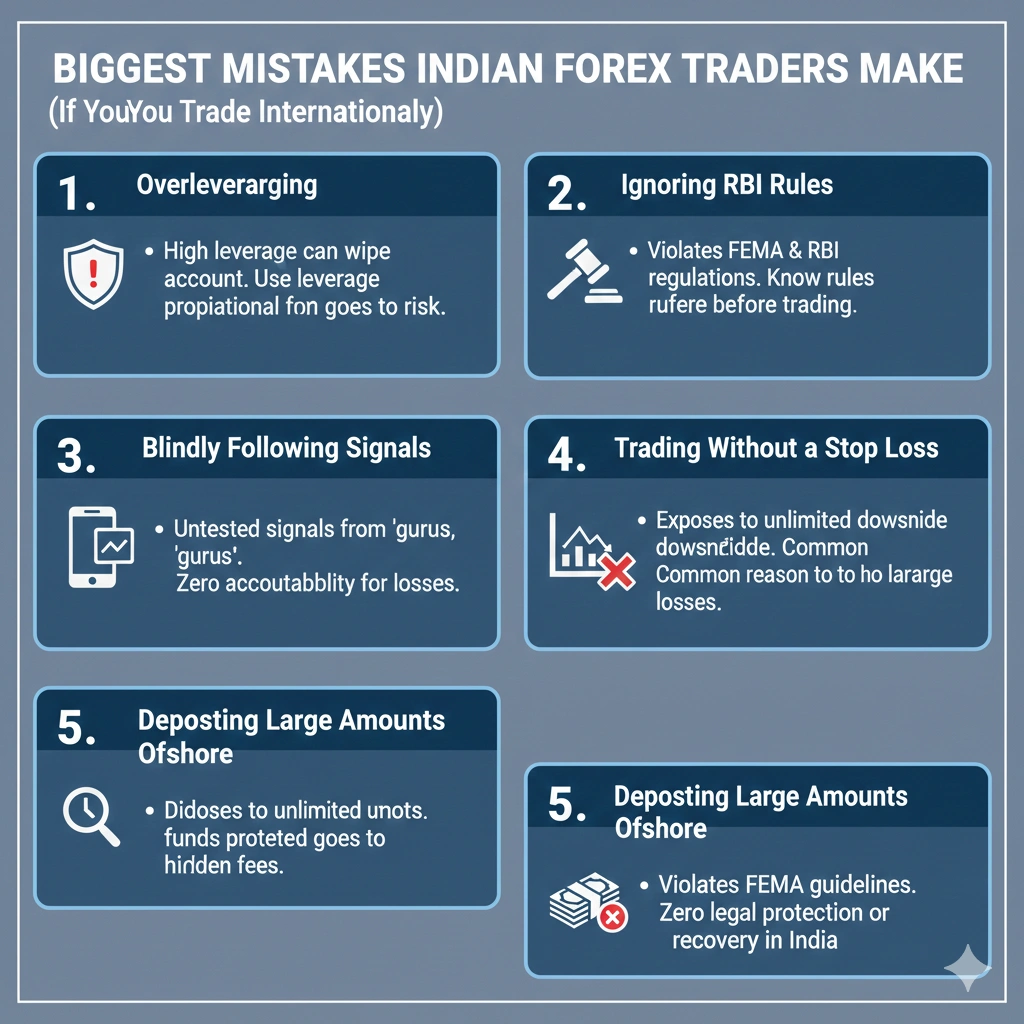
What Are the Biggest Mistakes Indian Forex Traders Make?
1. Overleveraging High leverage on offshore platforms can wipe out your entire account within minutes. Always use leverage proportional to your risk tolerance and account size.
2. Ignoring RBI Rules Trading offshore without understanding FEMA 1999 and RBI regulations for foreign brokers is not just risky — it is a potential legal violation. Know the rules before you trade.
3. Blindly Following Signals Telegram groups and social media “gurus” selling forex signals have no accountability. Most signals are untested, and losses from following them are entirely yours to bear.
4. Trading Without a Stop Loss On volatile pairs like EUR/USD or indices like US30, trading without a stop loss exposes you to unlimited downside. It is the single most common reason traders lose large amounts quickly.
5. Depositing Large Amounts Offshore Sending significant funds to offshore brokers not only violates FEMA guidelines but also puts your capital at serious risk with zero legal protection or recovery options in India.
FAQs
1. Is international forex trading legal in India?
Trading forex in India is legal only on recognized exchanges like NSE, BSE, and MCX-SX, and strictly limited to INR-based currency pairs such as USD/INR and EUR/INR. Trading non-INR pairs like EUR/USD through offshore brokers falls outside the legal framework defined by RBI and FEMA 1999.
2. Is forex legal offshore for Indian residents?
Offshore forex trading is not permitted under FEMA 1999 for Indian residents. While many traders do access offshore platforms, doing so carries regulatory, financial, and legal risk with no protection from RBI or SEBI in case of disputes or fraud.
3. Does RBI allow foreign forex brokers?
No. The RBI does not authorize, license, or regulate any foreign forex broker to offer services to Indian residents. Brokers operating without RBI authorization are listed on the RBI Alert List at rbi.org.in.
4. Can Indians legally trade EUR/USD?
EUR/USD is not available on Indian exchanges and is not a permitted pair under current RBI guidelines. Indian residents can only legally trade currency pairs involving the Indian Rupee on SEBI-regulated exchanges.
5. What are the consequences of offshore forex trading in India?
Under FEMA 1999, violations related to unauthorized foreign exchange transactions can attract penalties up to three times the amount involved. Additionally, funds held with unauthorized offshore brokers carry zero legal protection if lost or withheld.
GIFT City — The Legal Gateway for International Forex in India?
GIFT City, or Gujarat International Finance Tec-City, is India’s officially designated International Financial Services Centre (IFSC). Under the IFSCA (International Financial Services Centres Authority), traders and firms operating within GIFT City can access a broader range of international financial instruments, including some global forex instruments, under a different regulatory framework than mainland India.
While GIFT City doesn’t fully open up international forex trading in India the way offshore brokers do, it represents the most legally compliant pathway for Indian traders seeking global market access beyond INR pairs. Brokers registered under IFSCA are different from RBI-regulated entities and operate under a special zone framework.
Traders interested in a compliant path to international forex should explore IFSCA-registered brokers operating within the GIFT City IFSC framework before considering offshore alternatives.
Conclusion
The prospects of international forex trading in India are very lucrative, starting with trading EURUSD to global indices such as US30 and NASDAQ, but with risks attached. Offshore brokering offers greater leverage and international markets, but there is a grey area due to the RBI rules for foreign brokers and FEMA regulations. Indian traders should learn to get used to the legal environment and risk management and not to make typical mistakes, such as over-leveraging or neglecting stop losses.
Through relevant knowledge, discipline, and sensitization on whether Forex is legal offshore, traders are in a position to venture into international markets with minimal risks of incurring losses. Caution and education are the keys.
Ready to navigate international forex trading in India with clarity? InsightfulTrade provides legally guided forex education, smart trading tools, and expert market analysis built specifically for Indian traders. Start informed, trade smart.
Author: Arihant Jain
Trading Experience: 5+ Years
Arihant Jain is a financial markets analyst and trading educator with expertise in Forex, indices, crypto, and risk-managed trading systems. His insights are based on real trading experience, data-driven analysis, and transparent market understanding. All content is reviewed for accuracy and aligns with Google’s EEAT guidelines.
Risk Disclaimer:
Trading involves substantial risk. All information is for educational purposes only and should not be taken as financial advice. Always do your own research.
Last Updated: 25 February 2026