 Introduction
Gold is not just a shiny metal; it’s the world’s oldest financial instrument. It moves like a physical product on the basis of supply and demand, but it also reacts to macroeconomic trends, like war, inflation, and global growth. It’s both a piece of jewelry and people’s million-dollar savings. For traders and investors, understanding the gold price outlook is essential when analyzing XAUUSD movements.
When people are scared and the market is going through inflation or uncertainty, gold acts as a safe haven for traders. But it also has one weakness: that it gives 0% interest, and that’s why it suffers when the economy is growing and interest rates are rising. This blog provides a comprehensive breakdown of the key factors influencing the gold price outlook, explains how gold interacts with the U.S. dollar, and outlines what traders should watch when forming a gold movement forecast.
Gold in 2026: What’s Happening Right Now
Gold has been on one of its strongest bull runs in modern history, recently setting a new gold all-time high above $5,500/oz — a level few analysts predicted just two years ago. The XAUUSD current price reflects a market driven by institutional conviction, not just retail speculation.
Major institutional gold price targets from banks like J.P. Morgan, UBS, and Deutsche Bank now range between $5,000–$7,200/oz in upside scenarios — a dramatic shift from forecasts made just 18 months ago. This repricing reflects a structural change in how global capital views gold, not just a short-term gold bull run.
What’s fueling this? A combination of central bank gold accumulation, de-dollarization, a softening dollar, and persistent geopolitical risk has created conditions where gold isn’t just reacting to headlines — it’s being repriced as a long-term reserve asset.
Whether prices hold, extend, or correct from here, the macro case for gold remains one of the strongest in a generation.
Why Gold Matters in Global Markets
Gold is more than just a shiny metal, it is like a thermometer telling you whether the global market is healthy or sick. The gold price outlook is shaped by how investors feel, when traders are confident they move to the stock market. When they’re scared of losing their money they preserve it by moving to gold.
Gold matters because:
- It acts as a hedge against inflation and currency devaluation
- It attracts demand during geopolitical and financial uncertainty
- It reflects changes in real interest rates
- It plays a role in central bank reserve management
These characteristics make gold one of the most closely watched instruments in market analysis.
Understanding XAUUSD and Gold Pricing
In the global market, gold and the U.S. dollar are the ultimate rivals. Because gold is priced internationally in USD, any movement in the value of the dollar influences the gold’s market value instantly. It’s essentially about purchasing power: when the dollar is weak, gold looks ‘on sale’ to the rest of the world, driving up demand.
Key aspects of gold pricing include:
- Gold is priced internationally in U.S. dollars
- Dollar strength or weakness impacts gold demand
- Global liquidity conditions influence price trends
A clear understanding of this structure is essential when analyzing XAUUSD.
Gold vs Dollar Correlation Explained
One of the most important relationships in gold trading is the gold vs. dollar correlation. Historically, gold and the U.S. dollar tend to move inversely, although this relationship can weaken or strengthen depending on market conditions.
When the dollar strengthens:
- Gold often faces downward pressure
- Dollar-denominated assets become more attractive
- Gold demand may decline internationally
When the dollar weakens:
- Gold often benefits from increased demand
- Purchasing power improves for non-dollar buyers
- Gold becomes more attractive as a store of value
De-Dollarization: The Structural Tailwind for Gold
One of the biggest macro stories shaping the gold price outlook is de-dollarization — the global shift away from the US dollar as the world’s primary reserve currency.
Here’s why it structurally supports gold:
- Currency debasement and gold are directly linked — as central banks print more money, each dollar buys less, making hard assets like gold more valuable
- The US dollar purchasing power decline since the COVID era has accelerated the search for dollar alternatives among both institutions and sovereign nations
- Countries reducing US Treasury holdings are increasingly replacing them with gold — reinforcing its role as the world’s neutral reserve asset
- The de-dollarization gold price impact is not cyclical — it’s a slow, structural reallocation that builds over years, not months
Unlike interest rate moves or inflation prints, de-dollarization doesn’t reverse quickly. It’s one of the few drivers that supports gold’s long-term price floor regardless of short-term macro noise.
Interest Rates and Their Impact on Gold
Interest rates play a big role in moving gold’s price. Because gold does not produce yield, it is incredibly sensitive to what investors could be earning from the interest rates.
Key dynamics include:
- Rising interest rates cause gold prices to lose its shine
- Falling interest rates push gold price up
- Expectations of future rate changes influence price action
Central bank guidance and bond yield movements therefore play a major role in gold movement forecasts.
Inflation and Gold Price Outlook
People assume that the gold price will rise if inflation is rising, but this is not complete information. Gold is at its happiest when inflation rises and banks are paying low interest rates. But if banks start paying high rates to beat inflation, the gold price will fall.
Inflation affects gold through:
- Expectations of currency purchasing power erosion
- Central bank policy responses
- Investor demand for hard assets
Understanding how inflation interacts with interest rates improves the accuracy of a gold movement forecast.
Geopolitical Risk and Safe-Haven Demand
Recent years have clearly shown that gold is the market’s true safe haven. When the world was facing geopolitical or financial stress due to wars, trade tension and political instability, gold was busy crossing its all time highs.
During high-risk periods:
- People were buying gold to protect their capital
- Volatility increases across other financial markets
- Gold became more bullish, making new highs everyday
Safe-haven demand remains a key driver of gold price spikes.
Central Banks Are Quietly Reshaping Gold Demand
Central bank gold buying has become one of the most consistent demand drivers in the market. According to J.P. Morgan Research, central bank gold demand is projected to average 500–600 tonnes per quarter — a pace that would have seemed extraordinary just five years ago.
The People’s Bank of China gold reserves have grown steadily over consecutive months as part of a deliberate de-dollarization and gold strategy. European central banks, particularly Poland, have also emerged as significant buyers, reflecting a broader shift in foreign exchange reserve diversification away from US Treasuries.
This isn’t short-term trading — it’s structural. Emerging market gold demand from institutions signals that gold’s role as a reserve asset is being formally re-established at the sovereign level.
Gold ETFs and Investor Demand
Gold ETF inflows have become one of the most powerful demand signals in the market. In recent years, global gold ETF demand has surged — adding hundreds of tonnes annually to tracked holdings as both retail and institutional gold investment shifted decisively toward the metal.
Alongside ETFs, bar and coin gold demand consistently contributes over 1,000+ tonnes per year, reflecting strong physical conviction from private investors worldwide.
For traders, monitoring World Gold Council gold data on ETF flows is one of the most reliable ways to gauge whether institutional money is entering or exiting gold — often before it shows up in price action.
When ETF inflows rise alongside central bank buying, it creates a demand stack that’s historically difficult for sellers to overcome.
Gold Movement Forecast: Short-Term vs Long-Term
The gold movement forecast differs significantly depending on the timeframe. Events, headlines and chart patterns can cause short-term price action, while long-term trends are caused by macroeconomic forces.
Short-term drivers include:
- Economic data releases
- Sudden move in Dollar
- Change in interest rates
Long-term drivers include:
- Inflation trends
- Monetary policy cycles
- Structural demand from institutions and central banks
By combining this information with your strategies you can avoid reacting to the market emotionally.
Market Sentiment and Gold Price Outlook
The gold price often reflects how the world is feeling. Extreme optimism or pessimism in risk assets often spills over into gold markets. The gold price outlook often improves when risk sentiment deteriorates.
Market sentiment influences gold through:
- Investors risk taking capacity during uncertain market
- Professional traders moving the money to buying gold
- Both the banks and retailers buying gold
Understanding sentiment alongside fundamentals provides deeper insight into gold trends.
Technical Levels and Gold Trading Context
The macro data tells you the global market’s sentiment, but the technical analysis tells exactly when to execute your trade. By spotting the key support and resistance you can easily decide the entry and exit for your trade.
Here’s how pro traders analyze:
- By tracking trendlines
- Key moving averages
- High-volume zones
Technical structure complements macro-driven gold analysis.
Common Mistakes in Gold Price Analysis
Here’s the upgraded version with keywords and more depth:
Common Mistakes in Gold Price Analysis
Many traders misunderstand gold price behavior, leading to poor decisions and unnecessary losses.
Common mistakes include:
- Assuming gold always rises during inflation — it only thrives when inflation is high and real interest rates are low. When central banks raise rates aggressively to fight inflation, gold price outlook turns bearish
- Ignoring real interest rates — this is gold’s single most important variable. Traders who skip real interest rate analysis are essentially trading blind
- Overtrading short-term volatility — reacting to every headline without checking dollar direction and macro context leads to emotional, low-quality entries
- Separating gold analysis from dollar movements — XAUUSD price action cannot be read in isolation. The gold vs dollar correlation must always be part of your framework
- Ignoring central bank signals — central bank gold buying and Fed guidance move gold on a structural level that short-term charts simply won’t show you
Avoiding these errors doesn’t just improve accuracy — it’s the difference between trading gold reactively and trading it professionally.
How Traders Build a Professional Gold Price Outlook
Professional traders treat gold as part of a macro system rather than a standalone asset. A real trader builds their gold price outlook by connecting several different factors rather than looking for a single reason to buy.
From de-dollarization reshaping reserve flows to institutional gold forecasts ranging from $4,300 to $7,200/oz — the factors moving gold today are more structural than ever before.
A structured approach includes:
- They watch the US dollar and the bond yields
- They Track the inflation and watch the central bank’s every move
- They make sure that markets sentiment match with the price structure
- They avoid taking risk during any event
Gold Price Scenarios: Bull, Base & Bear Case
No one knows exactly where gold goes next — but professional traders always plan for all three outcomes. Here’s how the gold price scenarios break down:
| Scenario | Price Range | Key Drivers |
|---|---|---|
| Bull Case | $6,000–$7,200/oz | Fed rate cuts, geopolitical escalation, central bank accumulation, record ETF inflows |
| Base Case | $4,700–$5,500/oz | Rangebound dollar, moderate inflation, no major macro shock |
| Bear Case | $4,200–$4,400/oz | Hawkish Fed, rising real bond yields, geopolitical de-escalation |
Breaking each down:
Gold price bull case is supported by Fed rate cuts and gold price sensitivity — when real borrowing costs fall, gold’s zero-yield becomes irrelevant. Add escalating geopolitical risk and sovereign buying, and the upside case becomes compelling.
The base case assumes no major shock in either direction — moderate dollar strength keeps XAUUSD price prediction rangebound while underlying demand provides a floor.
Gold bearish risks center on the real bond yields gold correlation — if yields spike unexpectedly, capital rotates out of gold fast. A hawkish Federal Reserve or sudden geopolitical resolution are the two most likely bear triggers.
Smart traders don’t pick one scenario and commit — they identify which scenario is playing out in real time and trade accordingly.
What Top Banks Are Forecasting for Gold

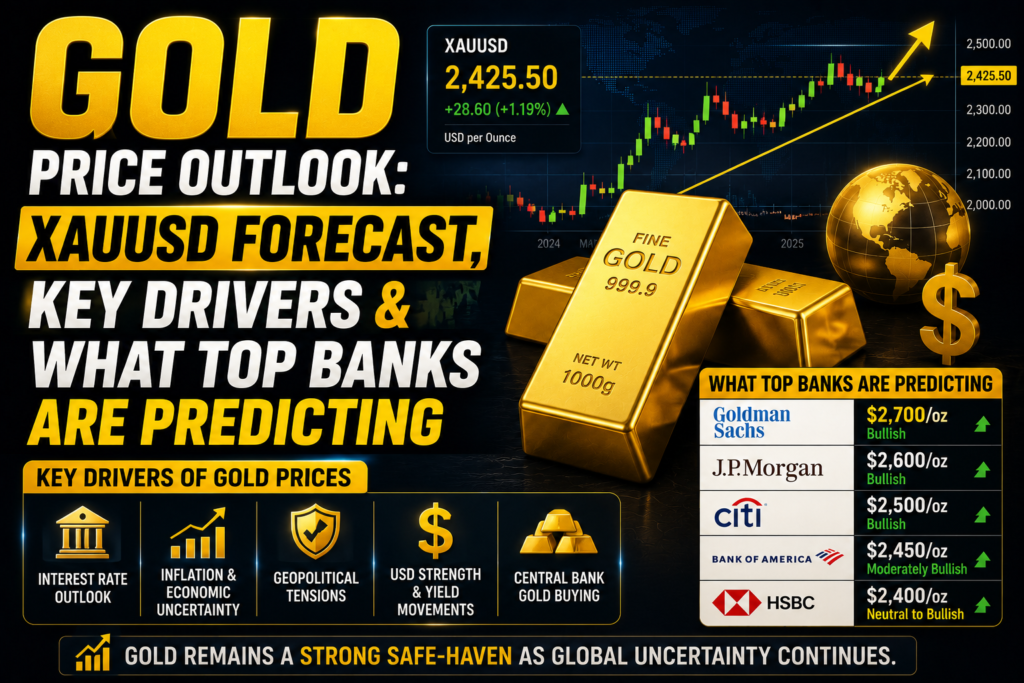
When institutional desks disagree this sharply, it tells you one thing: gold is at a macro inflection point. Here’s where major banks stand:
| Institution | Gold Price Target |
|---|---|
| J.P. Morgan | $5,000–$6,300/oz |
| UBS | $6,000 (upside: $7,200/oz) |
| Deutsche Bank | $6,000/oz |
| Wells Fargo | $6,100–$6,300/oz |
| Morgan Stanley | $5,700/oz (bull case) |
| Goldman Sachs | $4,900/oz (revised) |
| Commerzbank | $4,400/oz |
| Macquarie | $4,323/oz |
These forecasts represent a wide range of macro assumptions. Gold’s current price has already surpassed several base-case estimates — meaning the market is running ahead of consensus.
What this spread tells traders:
- Bulls and bears are both represented by credible institutions
- The $3,000+ gap between highest and lowest targets reflects genuine macro uncertainty
- When gold trades above consensus, momentum and sentiment are doing the heavy lifting
Conclusion
The gold price outlook isn’t just what the charts are showing — it’s the market’s reaction to the forces behind it: inflation, interest rates, and especially the dollar. Since gold is priced in dollars, they usually move in opposite directions, and if you can understand that relationship, you can trade XAU/USD with real precision.
You would never see a professional trader reacting to the headlines; instead, they try to look at the bigger picture – and analyze the trend in the market, the bank’s next move, and the global sentiments. With the increasing uncertainty in the market and monetary policy shifts, you need a disciplined and analytical approach to stick to the game rather than an emotional exit.
If you want to trade gold with confidence and clear understanding, then visit Insightful Trade’s website. They provide professional insights and training to help you analyze the market yourself and make confident trades.
FAQs
Q1: What drives the gold price outlook the most?
The biggest drivers are real interest rates, US dollar strength, inflation expectations, and global risk sentiment. When all four turn negative simultaneously — falling rates, weak dollar, rising inflation, geopolitical stress — gold tends to make its strongest moves.
Q2: How do real interest rates affect gold?
Real interest rates — nominal rates minus inflation — are gold’s most direct competitor. When real rates fall or turn negative, gold’s zero-yield becomes an advantage. When real rates rise sharply, capital exits gold for yield-bearing assets.
Q3: Is gold always a safe-haven asset?
Not always. Gold performs best during sustained uncertainty, but short-term volatility, margin calls, or a sudden dollar spike can push gold lower even during crises. Context always matters more than the label.
Q4: What is de-dollarization and why does it matter for gold?
De-dollarization is the global shift away from USD as the dominant reserve currency. As nations reduce US Treasury holdings and diversify into gold, it creates structural long-term demand that doesn’t disappear between news cycles.
Q5: What is the difference between short-term and long-term gold forecasts?
Short-term gold price movements are driven by data releases, dollar swings, and sentiment shifts. Long-term gold forecasts are shaped by monetary policy cycles, central bank demand, and structural trends like de-dollarization — which are far more reliable to trade around.
Q6: How do central banks influence the gold price?
When central banks buy gold at scale, they remove supply from the market while signaling distrust in fiat currencies. Sustained sovereign gold demand acts as a long-term price floor that private traders rarely have the power to break.
Author: Kumkum Chandak
Experience: 3+ Years in Trading Research & Market Content Strategy
Kumkum Chandak is a trading content strategist and market research writer who specializes in simplifying technical analysis, trading tools, and strategy-driven educational content. Her work is optimized for EEAT, accuracy, and user intent, ensuring every article delivers practical insights for traders of all levels.
Risk Disclaimer:
All content is strictly educational and not financial advice. Trading involves substantial risk. Always perform your own analysis or consult a professional advisor.
Last Updated: 28 February 2026