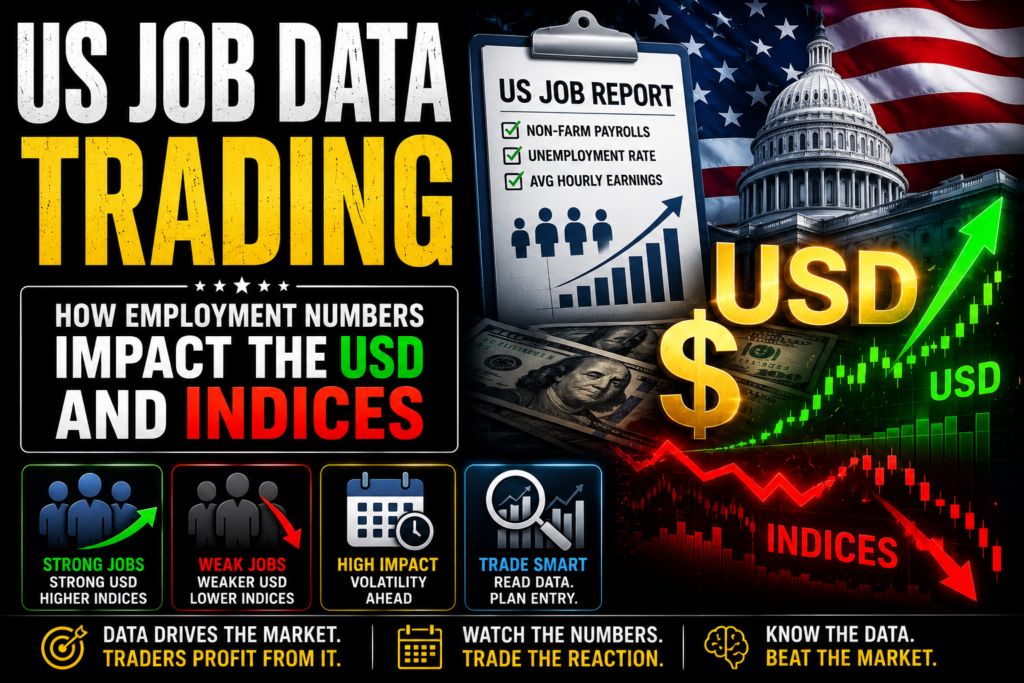
 The US labor market is crucial for the global economy; you can’t ignore it if you want to make money. Whenever the job reports come out, everything moves from currency pairs to the S&P 500. It’s not just numbers; they tell us about inflation and future interest rates. In this blog, we’ll understand further about US job data trading. So, stick to it till the end to make it your secret weapon for predicting market direction.
Why US Job Data Is a Critical Market Indicator
US employment data reflects the heartbeat of the world’s largest economy. Since consumer spending is nearly 70% of US GDP, that’s why job numbers have a direct influence over economic growth, inflation trends, and Federal Reserve policy expectations.
Here are the main labor reports traders watch closely:
- Non-Farm Payrolls (NFP) – It measures how many jobs were added monthly.
- Unemployment Rate – It is the percentage of unemployed workers
- Average Hourly Earnings – a key measure of wage inflation
- Labor Force Participation Rate – It measures the actual number of people willing to work.
- JOLTS Job Openings – It helps spot the job vacancies available across industries
These data points provide a near-instant snapshot of economic activity, making them essential for US job data trading.
How US Job Data Influences the USD
The US dollar (USD) is one of the first assets to react when job numbers are released.
When job data beats expectations
- Investors anticipate possible Fed rate hikes
- Treasury yields rise
- Foreign investment flows into the US
- USD strengthens against most major currencies
This can lead to sharp moves in pairs like EUR/USD, GBP/USD, USD/JPY, and USD/CAD.
When job data misses expectations
- Rate cuts become more likely
- Yields fall
- Safe-haven flows may increase
- USD weakens, sometimes sharply
For traders, this reaction is crucial to remember. It helps you anticipate any changes before they fully occur, giving you an edge in your US jobs data trading strategy.
Understanding the NFP Effect on Indices
Stock indices often experience some of their biggest intraday swings during NFP releases.
When NFP is stronger than forecast
The market reaction can be complicated:
- Positive economic momentum can support earnings
- But strong data may increase Fed tightening expectations
- This leads to short-term drops in indices like S&P 500 and NASDAQ
When NFP is weaker than forecast
- Weak data reduces rate-hike pressure
- Markets may rally on hopes of monetary easing
- However, long-term weakness can signal recession risks
Tech stocks and growth sectors are especially sensitive, as they rely heavily on interest-rate expectations.
This is why traders carefully monitor the NFP effect on indices before setting their trading plans.
Unemployment Trend Analysis: Predicting Market Cycles
While the headline NFP captures most of the market’s attention, unemployment trends offer deeper, long-term insights.
If unemployment keeps rising:
- Then it will Slowing the economic growth
- It will reduce the consumer spending
- Increasing the risk of recession
- It drag the USD down and often causes the Fed to cut the rates
If unemployment starts falling:
- It means more jobs and higher consumer demands
- Possible inflation pressure
- Stronger USD
- Mixed impact on indices depending on rate expectations
This makes unemployment trend analysis a valuable long-horizon tool for traders using macro-based strategies.
How US Job Data Affects Major Financial Markets
1. Forex Market
Currencies respond instantly to job data releases.
A strong labor report often triggers:
- USD rallies
- Sharp corrections in EUR/USD and GBP/USD
- Yen (JPY) weakness due to risk-on sentiment
2. US Stock Indices
NFP volatility impacts:
- S&P 500
- NASDAQ 100
- Dow Jones
Traders often see extreme intraday moves around major support/resistance zones.
3. Gold and Commodities
Gold reacts strongly due to its inverse relationship with the USD and yields.
- Strong data → USD rises → gold falls
- Weak data → USD weakens → gold gains
Oil moves based on economic demand expectations tied to job growth.
4. Bonds and Yields
Bond markets often move more dramatically than stocks or forex.
- Strong data → rising yields
- Weak data → falling yields
Because yields directly influence indices and forex, job data creates ripple effects across global markets.
Recent Examples: How Job Data Moved Markets in 2024–2025
Recent labor releases have triggered significant volatility:
- Thanks to a stronger-than-expected report on NFP, the USD/JPY blasted right through a major resistance level.
- US indices were dropping sharply, but later they made a U-turn comeback after the news of a healthy labor market.
- Gold experienced rapid swings, moving more than $20 per ounce within minutes.
- The DXY (US Dollar Index) posted one of its strongest weekly gains following a major labor beat.
These examples show how powerful US job data trading can be—especially during unpredictable market phases.
Trading Strategies for US Job Data Events
Because job reports often create sudden volatility, traders must approach them with discipline.
Patience Pays Off
Avoid taking trades just before the announcement. The liquidity runs out just before the news, and the spreads become expensive—it’s not worth the expense.
Pick your plan
Decide in advance if you are looking for a breakout or a reversal. Your strategy should depend on where the market is sitting before the news hits.
Read the Fine Print
Even though sometimes the news is great, the market drops. Why? Usually because wage growth or participation rates were weak. Watch the whole picture.
Follow the Big Current
Analyze the long-term unemployment rates. It helps you avoid getting trapped in short-term noise that goes against the major market direction.
Safety First
During the volatile market, you should manage your risk properly and also reduce the position size.
Let the Dust Settle
It’s recommended to wait for 5-15 min, let the market settle, and then make an entry with a clear mind and better setup, avoiding FOMO.
How to Prepare for the Next NFP

Here’s a straightforward pre-NFP checklist:
- First you need to check the previous reports to see whether there is any improvement or not.
- Then check what the market expects. Because the reactions happen when the actual number shocks the consensus.
- Actively watch treasury yields, as they move faster than stocks or currencies and can help predict the market’s next move.
- Identify the support and resistance levels on USD pairs and indices
- Trade with small lot sizes and stop-losses for less risk.
This approach prepares traders for the NFP effect on indices and USD volatility.
Conclusion
The US labor market is the engine that drives the global market. Whether you trade forex, equities, commodities, or bonds, these monthly reports bring both big risks and big rewards. That’s why, by mastering US job data trading, looking at the past results, and doing deeper analysis, you can stop guesswork and start executing your strategies. With the correct preparation, the market volatility stops being a problem and starts being your biggest advantage.
For deeper market insights, trading tools, and expert-driven analysis, explore Insightful Trade, your partner for smarter and more confident trading decisions.
FAQs
- How does US job data impact the USD?
Strong job data strengthens the USD by increasing expectations of Fed rate hikes, while weak data typically weakens the dollar.
- What is the NFP effect on indices?
NFP often causes immediate volatility in indices such as the S&P 500 and NASDAQ due to changing expectations around economic strength and interest rates.
- Why is analyzing the unemployment trend important?
It tracks long-term economic indicators and helps traders predict market direction in currencies, stocks, bonds, and commodities.
- Does job data affect gold prices?
Yes. Strong job data often pushes gold lower due to a stronger USD, while weak data tends to support gold.
- What are the most volatile forex pairs during NFP?
EUR/USD, GBP/USD, USD/JPY, and XAU/USD typically show the largest volatility during job data releases.
Author: Kumkum Chandak
Experience: 3+ Years in Trading Research & Market Content Strategy
Kumkum Chandak is a trading content strategist and market research writer who specializes in simplifying technical analysis, trading tools, and strategy-driven educational content. Her work is optimized for EEAT, accuracy, and user intent, ensuring every article delivers practical insights for traders of all levels.
Risk Disclaimer:
All content is strictly educational and not financial advice. Trading involves substantial risk. Always perform your own analysis or consult a professional advisor.
Last Updated: 9 December 2025