Introduction
If you’re thinking that you missed the entry, then don’t worry; you’re not alone. Traders like you are always in fear of chasing the trend in the market; in this situation of fear, the pullback trading strategy can help you as a game-changer and savior that can transform your trading discipline.
In this guide, we’ll discuss what pullbacks are, how to trade, and how you can use them in your trading routine. Let’s discuss it together.
What Is the Pullback Trading Strategy?
A price action approach is used widely where many traders, like you, enter a trade after a temporary correction in an ongoing trend. At the time of strong market movement, waiting for the price to “pull back” instead of jumping or making any rash decision is known as a pullback. It provides a better entry point and improves the overall risk-to-reward ratio.
- In an uptrend, the price makes higher highs and higher lows.
- In a downtrend, the price forms lower lows and lower highs.
If you’re a beginner or an experienced trader, it’s a lower-risk way to trade trending markets by preventing impulsive entries and increasing patience. The best pullback entries occur when the price retraces to key technical levels and refer to the most favorable point in trading. Now, let’s see why traders use the pullback trading strategy.
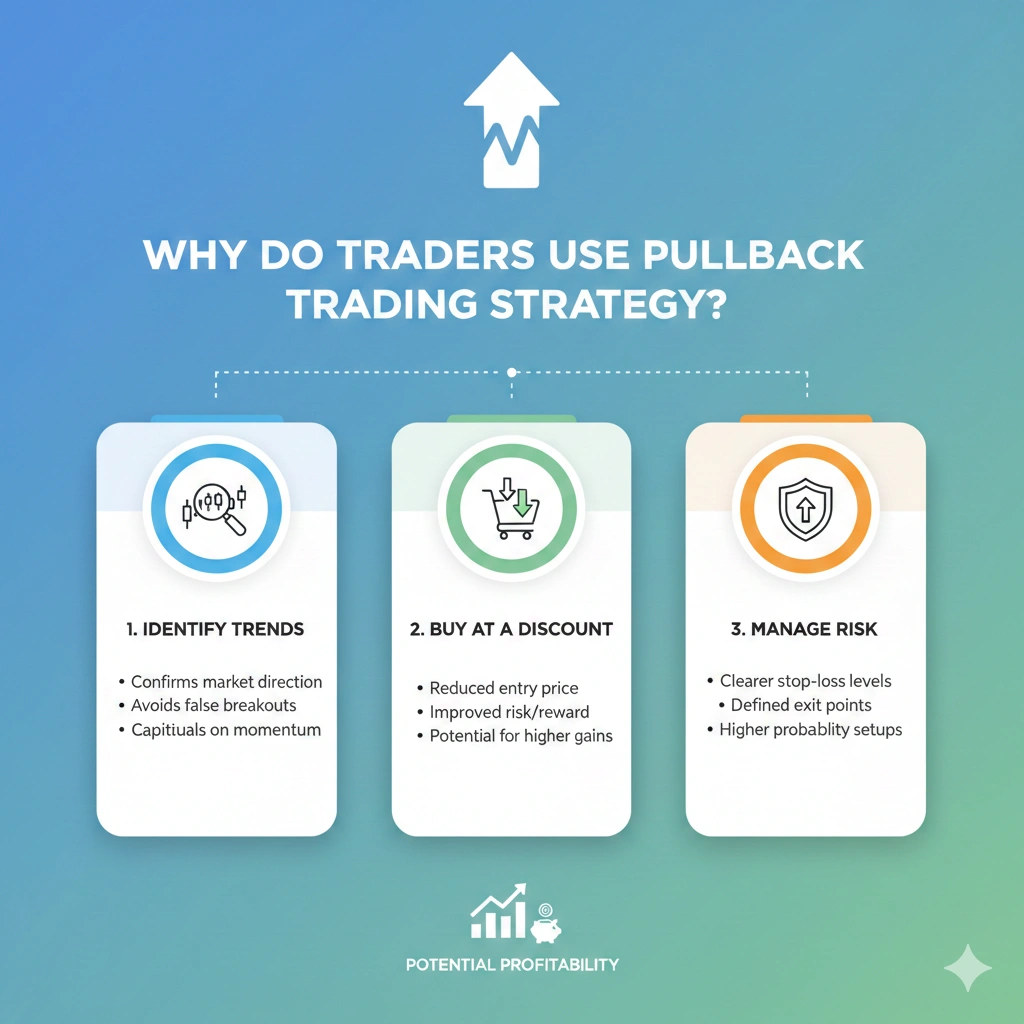
Why Do Traders Use It?
There are some key reasons for using this strategy by traders, and they are
- If you’re a beginner, it can be easier for you because it is very easy to understand and apply.
- It works in every market, whether it is forex, stocks, crypto, or indices.
- It provides a better risk-reward ratio to make trades more efficient.
- It allows you to enter strong trends without buying too high or selling too low.
- Promotes patience and discipline to reduce emotional trading.
- At the time of temporary retracements, it provides low-risk entry points.
How Do You Trade a Pullback Step by Step?
Here’s a step-by-step guide for you that tells you how to trade a pullback:
- Determine the trend using higher highs/lows or moving averages.
- Find temporary retracement and wait for a pullback.
- Manage your trade by adjusting stop-loss and take-profit before any trade.
- Get the confirmation for reversal to ensure the trend is resuming.
- Locate key levels by using trendlines, moving averages, or swing points.
Which Types of Pullbacks Should a Trader Know About?
Being a trader, you should definitely know about some types of pullbacks. Here are the important ones:
- Minor Pullbacks
- Moderate Pullbacks
- Deep Pullbacks
- Complex Pullbacks
- Swing Pullbacks
- Intraday Pullbacks
Knowing about these types can help you in adapting your strategy across different markets and timeframes.
Trend Continuation Methods in Pullback Trading Strategy
Here are the best trend continuation methods for traders:
- Moving Average Bounce—This technique shows the consistent step into the market of buyers and sellers.
- Fibonacci Retracement Levels—A tool that is used to spot trend continuation during a pullback and reduces the emotional trading and improves accuracy for any trader.
- Candlestick Confirmation—A powerful and crucial method that improves entry timing and aligns traders with the dominant trend while maintaining the risk.
- Break-and-Retest Setup—A highly effective trend continuation method that provides a low-risk entry with the setting of a stop-loss.
- Trendline Rejection—With the help of it, you can avoid false breakouts because it shows how strongly the market respects a trend’s structure.
If you use these tools, these will reduce the risk of entering into a trade too early or late and improve risk management. These allow you to increase consistency and smoother moves within strong trends.
How Do You Avoid Fake Pullbacks?
To avoid pullbacks:
- Check the strength of the trend because weak trends produce fake signals.
- Extreme depth pullbacks can signal reversal.
- On higher timeframes, check trend direction.
- Ignore news events that can create false signals.
- Focus on candle structure, not too small nor too large.

What Are the Most Common Mistakes Traders Make With the Pullback Strategy?
- Enter too early
If you jump into a trade too early during the price retracement, it often leads to losses.
- Placing stop losses too tight
Setting stop-loss too close often gets triggered by normal market changes that can lead to premature exits.
- Rely only on one indicator
Always check multiple indicators because trends can look different across timeframes.
- Ignoring Higher Timeframes
It is also a mistake if you are also ignoring higher timeframes that can increase the risk of entering trades.
- Overleveraging
If you’re using excessive leverage, in case the market moves against your trade, it can magnify losses.
- Don’t wait for confirmation candles
Not waiting for confirmation candles can be risky for your trade. If you wait for it, you can ensure high-probability setups in your trade.
Is Pullback Trading Suitable for Beginners?
Yes, absolutely, if you’re a beginner, it is suitable for you. Here’s how it is easy for you:
- Pullback has a straightforward concept, which is easy to understand for new traders.
- It helps beginners in protecting their capital by lowering the risk because of tighter stop-loss levels.
- It prevents impulsive or rash decisions and encourages patience.
- It works in all timeframes, such as intraday or swing trades.

Real Market Example: How a Pullback Strategy Works (EUR/USD)
Let’s break down a simple example to understand how a pullback strategy works:
Imagine EUR/USD is in a clear uptrend that forms higher highs and higher lows. The price rises from 1.0700 to 1.0800 and pulls back to 1.0750.
- At this point, traders wait for a pullback before entering the market.
- After some time, when the market moves back to the previous breakout zone and pulls back to 1.0710-1.0700.
Entry: You place an order of 1.0710
Stop-loss: Stop-loss is placed at 1.0670
Take profit: Set a target at 1.0800, followed by 1.0860 if momentum continues.
This example shows how a pullback gives you a low-risk option and helps you ride the trend.
Frequently Asked Questions
- Is pullback trading profitable?
If you execute it in the correct way, it can be profitable for you and also increase the probability of successful trades over time.
- What is the difference between a pullback and a reversal?
Reversal is a complete change in trend, while pullback is temporary price movement against the trend.
- What is the best timeframe for pullback trading?
It totally depends on the style of your trading, and always check higher timeframes for trend confirmation for more reliable pullback trades.
- Which indicator works best for pullbacks?
If you combine any indicator with a pullback, it will improve accuracy, such as 50 EMA, 20 EMA, RSI, and Fibonacci retracement levels.
- Can I use a pullback strategy for intraday trading?
Yes, it is good and effective for intraday trading, where traders can enter positions at lower risk and high probability.
Conclusion
Wrapping it up, if you still have this question in your mind, what is the best beginner strategy in 2026? Then, yes, it is a highly effective and simple strategy. Identifying a pullback trading strategy requires patience and practice. Not every move against the trend needs to be a pullback; it can be a trend reversal. If you use it correctly, it becomes a powerful tool that effectively manages risk and also provides a high-probability setup in trending markets.
If you manage it properly, it can definitely help you build a strong trading system around pullbacks. To get expert market insights and proven strategies, join InsightfulTrade to boost your trading accuracy. Start learning safer and smarter today!
Author: Arihant Jain
Trading Experience: 5+ Years
Arihant Jain is a financial markets analyst and trading educator with expertise in Forex, indices, crypto, and risk-managed trading systems. His insights are based on real trading experience, data-driven analysis, and transparent market understanding. All content is reviewed for accuracy and aligns with Google’s EEAT guidelines.
Risk Disclaimer:
Trading involves substantial risk. All information is for educational purposes only and should not be taken as financial advice. Always do your own research.
Last Updated: 16 December 2025